New Talents in Climate Research: Maaike Jansen
“I know when something is good enough, which is a useful character trait when conducting historical research, where there are always more sources to be found.”
23 February 2026
How exactly do you approach such research?
“I am investigating how Dutch governments, businesses and civil society in the twentieth century – in response to the environmental problems that arose after the emergence of the consumer society – tried to control the growing mountain of household waste.
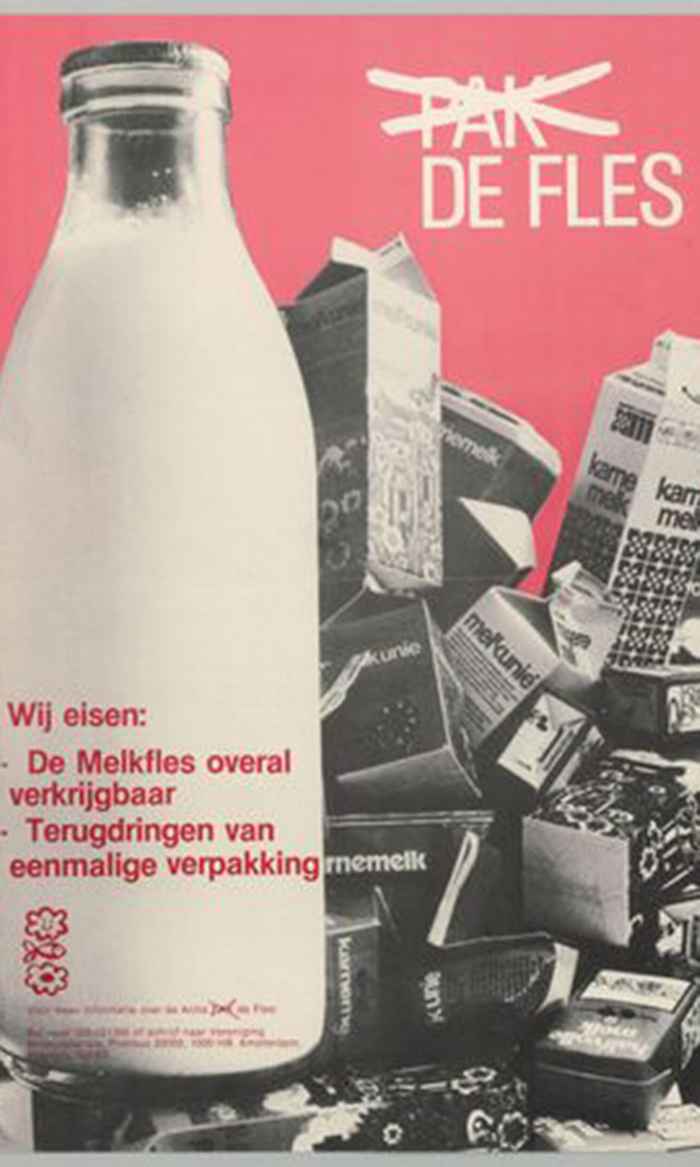
I am conducting this research based on three sub-topics, corresponding to three waste processing strategies: Refuse, Reuse, and Recycle. By taking one of these Rs as the starting point for each case study, it becomes clear how consumers were encouraged to choose glass milk bottles instead of cardboard milk cartons; how the emergence of thrift shops stimulated the reuse of waste materials; and how the debates surrounding the recycling of vegetable, fruit and garden waste unfolded. In this way, I hope to paint a picture of how household waste was handled in the Netherlands, in which topics such as gender and the used materials played important roles.”
Why did you choose these particular research questions?
“During my bachelor's degree in history at the University of Amsterdam, I became interested in consumer history. Later, during my research master's degree in history (also at the University of Amsterdam), I developed an interest in environmental history. The combination of these two fields quickly led me to the subject of waste, because it brings together the inextricably linked topics of consumption and the environment.
In my research question, I focused on the environment because I am interested in how environmental concerns have influenced our view of waste. People began looking for what was “best for the environment,” a question that elicited different answers from different perspectives, sparking discussion and friction. I am interested in where and why that friction occurred, and who was involved. By focusing on the three “sectors” of government, business, and civil society, I hope to gain insight into their interactions: did they work against each other, or did they work together?”
Waste is still a topic being experimented with in many ways, and its consequences cannot always be foreseen.
What do you hope to achieve with your research?
“Household waste is a topic that has not yet been researched extensively in the Dutch context. Through my research, I hope to provide insight into the efforts to reduce the waste mountain and why those efforts may not always have been successful. Waste is still a topic being experimented with in many ways, and its consequences cannot always be foreseen. Take, for example, the deposit system introduced for cans. Since then, litter bins everywhere have been opened and emptied by people looking for cans to cash in their deposit, a problem that people are trying to solve by, for example, attaching special racks for cans to the bins.
Such changes often spark debate: people complain about shopping bags getting dirty because the cans leak, there are too few collection points, or the machines are often broken. Further back in time, there are also numerous examples and changes that led to such debates. I am interested in this and hope to learn more.”
That moment when you don't yet know what you're going to find, and every page you turn is a surprise and can offer new insights.
Who are you working with?
“My research will mainly be an individual project, in which I am receiving excellent guidance from my two supervisors, Peter van Dam and Tim Verlaan. The further the research progresses, the more I hope to share my findings and expand my network. For example, this summer I will be presenting my research at a conference on recycling organised by the Technical University in Berlin. That's another reason why I think it's great that SEVEN provides a platform for young researchers to share their work with a wider audience.”
Which phase of the research do you find most interesting?
“My heart really lies in doing archival research. That moment when you don't yet know what you're going to find, and every page you turn is a surprise and can offer new insights. But I also really enjoy organising the findings from a large amount of archival material to create a coherent narrative.”
What I am very happy about, is the fact that I am able to maintain a good overview.
What are the challenges or obstacles for you?
“I always find rewriting a challenging phase: you already have a text, and you try to improve it based on new sources you have found or new themes you want to add. I see it as a puzzle where you hope that certain pieces will eventually fall into place.
Another obstacle in writing this chapter was that many company archives are not maintained or accessible. Companies have often merged with other companies over time or continued under a different name. As a historian, you hope that such a company at least knows its predecessors and, in the best case, has preserved material from that period, but I find that this is usually not the case. As a researcher, you then have to rely on material that may be stored in other archives or on newspaper articles in which these companies are mentioned.”
What character traits are you most proud of?
“What I am very happy about, is the fact that I am able to maintain a good overview. This helps me in a practical sense, for example, by making feasible plans, knowing what still needs to be done and keeping track of documentation of sources and notes. It also helps me with content, because maintaining an overview lets me easily connect different subjects or historical developments.
Furthermore, one of my supervisors once described me as “not too perfectionistic”: I know when something is good enough, which is indeed a useful character trait when conducting historical research, where there are always more sources to be found, more literature to be read and more information to be written down. Knowing when something is good enough helps to avoid falling into this endless trap.”
What would you still like to learn in the coming years?
“For the second part of my research, which focuses on how the emergence of thrift shops promoted the reuse of waste materials, I hope to be able to use oral history. This is a completely new research method for me, which I hope to explore further.
Although we may not immediately associate thrift shops with waste today, my preliminary research showed that the first thrift shops to emerge in the Netherlands in the 1980s collected and reused waste. Because few thrift shops have kept their own archives, and I don't want to rely solely on sources like newspaper articles, I hope to find people who were involved in the emergence of these thrift shops at the time and can tell me more about their history.”
Who is your greatest hero in science?
“Although I am not yet completely familiar with the world of oral history, this question immediately brings to mind the recently deceased Selma Leydesdorff, emeritus professor of Oral History and Culture at the University of Amsterdam and founder of the field of oral history. As written in her obituary, Selma saw ‘oral history as a unique opportunity to give a voice to what had been suppressed, forgotten or unspeakable’. With this conviction, she brought about a new kind of historiography, which today has a firm place not only in the academic world but also beyond. I can't wait to delve deeper into oral history.
Some people around me find it incomprehensible that I still have the time and energy for a PhD alongside my work, but it usually just gives me new energy.
What are your plans after completing your PhD?
“I know from experience that it works best for me if I don't think too much about what comes next. Because I've only just started and I'm combining my research as an external PhD student with my regular job as a Research & Heritage project assistant at the Netherlands Institute for Sound and Vision, that ‘next’ is still a long way off – about five years. My supervisors are helping me keep my options open, for example, by advising me to write in English rather than Dutch so I can reach a wider audience, and by helping me think about ways to present my work in the coming years. If I want to continue in academia, it's good to gain that experience.
Furthermore, I think it is especially important to continue to enjoy the coming years. Some people around me find it incomprehensible that I still have the time and energy for a PhD alongside my work, but it usually just gives me new energy. I am leaving the future open for now; first, a few more years of diving into archives, collecting stories and discovering what our history of waste has to tell us today.”