Luuk Huitink appointed Professor of Greek and Latin Literature in Context
8 May 2026
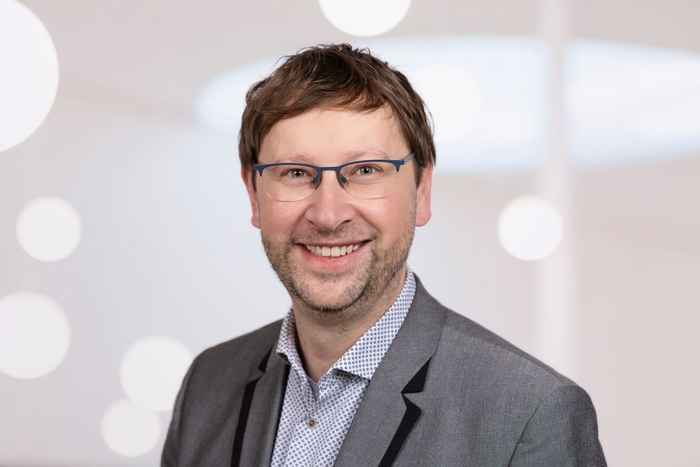
In his research, Huitink is occupied, among other things, with the question of how ancient authors provide coherence and meaning in their historical narratives to what is, in fact, a collection of isolated events. How do they get readers to contemplate, feel and evaluate the past? In addition, he studies the Greek and Latin rhetorical traditions, in which the Greeks and Romans reflect themselves on the effects of language and ways of reading.
‘In treatises and handbooks, you see that they often approach imagination and the reading experience in a surprisingly “embodied” way,’ says Huitink, ‘which closely corresponds to modern cognitive theories on embodiment. On the basis of that perspective, I have expanded my work further into the social psychology of the ancient world – among other ways within the NWO Gravitation programme Anchoring Innovation – again in dialogue with contemporary concepts.’
Classical Antiquity as a sounding board
In his teaching, the professor believes it is important for students of Greek and Latin language and culture to become skilled readers: meticulous and sensitive to language, rhetoric and context.
In the degree programme Ancient Studies, the emphasis is placed on the ancient world over a long period of time and encompassing its entire geographical spread. ‘Within Ancient Studies – a programme that we design in collaboration with archaeologists and historians – we tackle major, interdisciplinary questions about Classical Antiquity’, Huitink says.
Throughout Western history, the Greeks and Romans have repeatedly been invoked and used for all kinds of purposes.
‘We cannot simply “draw lessons” from Antiquity, but the ancient world can serve as a distant sounding board. By studying how the Greeks and Romans dealt with difficult issues, and how dependent they were on their own conceptual frameworks and assumptions, we gain a clearer perspective on the present. We learn to recognise the historical specificity of our own assumptions.’
Critical outlook on heritage
Huitink is looking forward to his new role as professor. ‘The UvA has a long and strong tradition of studying Greek and Latin, which we now offer in joint BA and MA programmes together with our colleagues at the VU. I look forward to working with our diverse team to further shape classical studies in Amsterdam.’
‘I think it is important that we contribute to the humanities as a whole on the basis of strong disciplinary expertise. Greeks and Romans still play a major role therein – not because we are automatically the “heirs” to that classical tradition, but because, throughout Western history, the Greeks and Romans have repeatedly been deliberately invoked and used for all kinds of purposes, for better or for worse. A critical outlook on that heritage remains necessary.’