Crossing Language Borders: Taking psycholinguistics into the field
by: Floor van den Berg, Emma Bierings, & Corrine Foko Mokam
14 April 2026
Empirical bias in psycholinguistics
“Psycholinguistic research has already taught us a lot about how people process multilingual speech, but this is mostly based on participants from so-called WEIRD societies: Western, Educated, Industrialized, Rich, and Democratic”, Floor points out. “In addition, the majority of psycholinguistic research on multilingualism focuses on a relatively small number of languages and language combinations spoken around the world. If we really want to understand how multilingual minds work, we need to go beyond WEIRD contexts and investigate under-researched language combinations including minority languages, indigenous languages, and dialectal varieties.”
'If we want to understand how multilingual minds work, we need to go beyond WEIRD contexts and investigate under-researched language combinations including minority languages, indigenous languages, and dialectal varieties.'Floor van den Berg
The multilingual ecology of Belize is one such community. “In Belize, multilingualism and code-switching are not the exception but the norm”, Emma explains. “People move fluidly between English, Spanish, and Belizean Kriol, often within a single sentence. Sometimes, they add indigenous languages to the mix, such as one of the three Mayan languages (Yucatec, Q’eqchi’, Mopan) spoken in Belize, or Garífuna. This ‘pool’ of languages where these speakers select from makes Belize an interesting place to study how people seem to effortlessly produce, process, and socially embed code-switched speech, not only on an individual level but also community-wide.”
Corrine: “Although Porto-Novo, Benin offers a very different multilingual ecology, it is also characterized by frequent code-switching and mixing, in this case between regional languages such as Gungbe and Fongbe, and French, the country’s official language. By doing our research in both Belize and Benin, we can shed light on the linguistic, social, and cognitive factors underlying the production and processing of code-switching.”
A portable lab in a suitcase
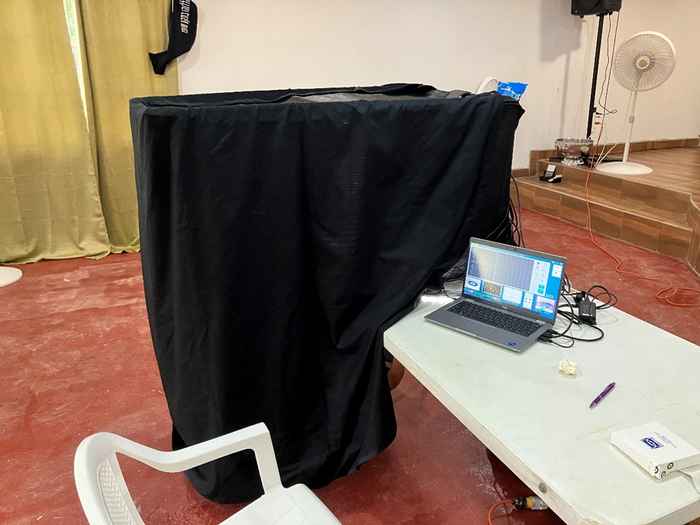
For the purpose of this fieldwork, the team developed PORTAL; a Portable Observatory for Research in (Eye-)Tracking, Attention, and Language.
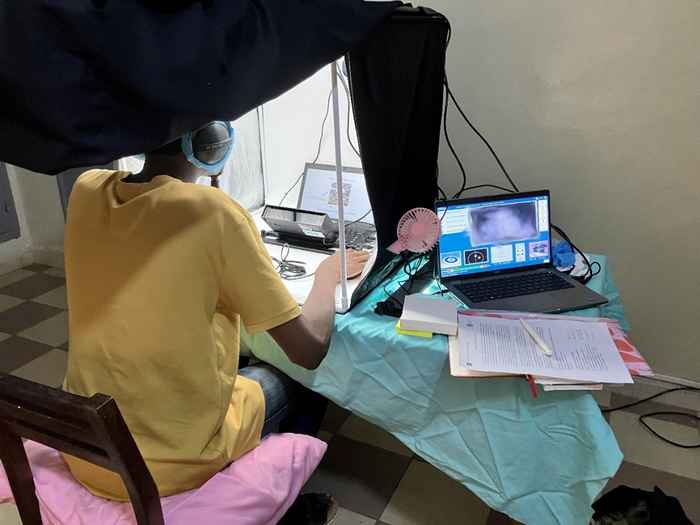
Floor: “Pupillometry – measuring changes in pupil size – allows us to track cognitive effort during language processing. But pupil size can be influenced by many factors, the most obvious one changes in light. In a regular lab, we can control lighting conditions carefully. In the field, that’s a whole different story.”
Instead of formally inviting multilingual community members to a traditional university lab setting, the researchers took the lab directly to the language contact situations themselves. Emma came up with the idea of using a portable photo studio to create this novel lab set-up: “PORTAL is essentially a lightweight, collapsible photo booth that blocks ambient light. With the curtain lowered, it creates stable lighting conditions even if we’re working in a church, a hotel room, or outside. It also helps participants feel less observed. And we can keep participants relatively cool, using the fans inside PORTAL to promote airflow.”
Transporting PORTAL and the eye-tracking equipment across continents and locations was an adventure in itself. Floor: “The lab itself weighs around 5 kilograms, and when collapsed, it fits in a large suitcase – but just barely. And the eye-tracking equipment itself must be transported in your carry-on luggage. So, packing strategically is key…” Emma adds: “Considering the many situations and locations in which we successfully set up the lab, we can conclude that it was all worth it – it worked!” For Floor, Emma, and Corrine, using PORTAL on fieldwork was a great learning experience. “Although there were practical challenges such as navigating transportation logistics, tropical temperatures, and power outages, you quickly learn to be flexible and to prepare for the unexpected!”, according to Floor.
What did participants have to do?
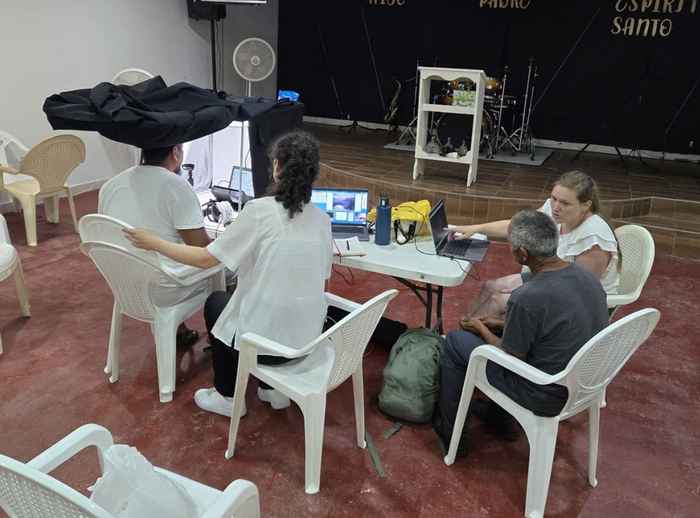
In addition to the pupillometry experiments run at both sites, participants completed several other tasks. In Benin, participants were also paired together to play a game eliciting two mixed linguistic patterns: yes/no questions and predicative adjectives.
In Belize, participants also did a language identification task, in which participants received auditory (unilingual and multilingual) stimuli in English and the English-based Belizean Kriol, and made decisions based on the language(s) they heard. Another task, that did not involve PORTAL, was a sentence repetition task, again with multilingual auditory stimuli. In between hearing the stimulus sentence and repeating it, participants were distracted with a short memory task. Most participants thought this was a fun memory game to participate in.
Both in Benin and Belize, a social network survey was run to capture the demographic information of participants, their language background, their code-switching and mixing practices, and how they distribute their languages with different people and across everyday settings.
Why this matters
Much experimental evidence suggests that code-switching is inherently more effortful than using or processing a single language. But this evidence largely stems from laboratory studies in Western contexts.
Floor: “If code-switching were costly in general, why would so many communities seem to do it effortlessly every day? Part of our work tests the idea that any ‘costs’ depend on individual experience and community norms. What is effortful in one community may be completely natural in another.”
'We’re learning from the communities we work with. That ultimately leads to more representative science that reflects the global reality of multilingualism.'- Emma Bierings
By bringing high-quality experimental methods to under-represented settings, such as Belize and Benin, the Crossing Language Borders project opens the door to more inclusive and ecologically valid language science. Emma: “In our work, we’re not just exporting lab methods and linguistic materials to the situation in the field, but we’re adapting them. We’re learning from the communities we work with. That ultimately leads to more representative science that reflects the global reality of multilingualism.”
Fieldwork memories
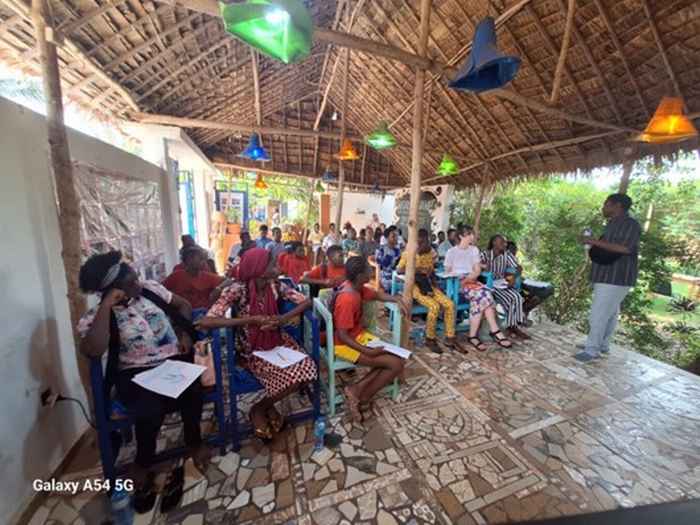
But fieldwork is rarely just about collecting data. The research team also made sure to organize events involving the local communities in discussions about the beauty and benefits of multilingualism. Attendees drew their personal language portraits and received a demonstration of the eye-tracking set-up with PORTAL. Corrine: “It was nice to have both university students and pupils reflecting on their language practices. They were quite happy to realize that it is not so bad that French stretches occur in their everyday speech. The event was also an occasion to empower Beninois junior linguists by discussing development opportunities with them, such as contributing to academic research and participating in the African Linguistics School.”
Finally, the fieldwork was an immersion into local daily life that allowed the research team to discover the wonderful communities of Belize and Benin. Emma: “Walking around in Orange Walk in Belize and hearing everybody (seemingly effortlessly) switch between the languages in their linguistic repertoire, was already a great experience on its own. Those were the moments that peaked my curiosity levels about code-switching. Hearing people’s stories, visions, and explanations about what mixing these languages means for them makes the fieldwork most memorable.”