Vossius Research Fellow: José Vieira Leitão
31 March 2026
About the project:
Learned magic represents a longue durée literary tradition that had major developments in Europe from the 13th century onward. Here, this crystalized into several practices, such as natural magic, astral magic or ceremonial magic, some of which were accepted as licit and others heavily condemned and persecuted.
While magic (be it learned or otherwise) has become a mostly normalized topic of historical inquiry, its complex position in European intellectual history places several conditions on its general or global understanding. The borders of magic are porous, not only between distinct forms of magic, but also regarding other ‘categories of knowledge’, such as science or religion. Furthermore, the drawing and negotiations of these borders tend to be contextual and culturally dependent; there are local religious, legal, bureaucratic and academic variations on the definition of magic, and within the same context, these will also vary with time.
Overall, my research seeks to understand magic in early modern Iberia and Iberian-influenced spaces. As such, much of this consists in the systematic exploration of Inquisition archives and convent and monastery library catalogues. This form of work has been very successful in mapping the social and institutional dynamics of magic practice and the circulation of magical texts between the Iberia, Europe and the larger trans-Atlantic world. However, this has also brought to light several difficult and unresolved historical problems, such as those resulting from the discovery of a small number of astral magic texts in the archives of the Cuenca Inquisition (Castilla-La Mancha, Spain). While not innovative in themselves, these texts have proven difficult to contextualize in the broader cosmopolitan world of learned magic. Internationally, astral magic is taken as having its peak in the 14th and 15th centuries, losing its popularity after this period, but these Iberian texts all date from the 17th and are part of a still lively tradition of astral magic also detectable in several trials from the Lisbon and Toledo Inquisitions.
An approach that can be taken to try to understand such obscure Iberian manuscripts is to ‘force’ a comparison between them and other non-Iberian early modern astral magic texts in search of common textual patterns, symbolic representations, incantations or procedures. In this way, Amsterdam presents itself as an optimal location for such academic explorations given the accessibility to the Bibliotheca Philosophica Hermetica (BPH) collection, currently divided between the Allard Pierson and the Embassy of the Free Mind.
Besides this immediate objective of Iberian textual contextualization, the systematic analysis of the BPH collection also provides an opportunity to understand the general trends and evolution of astral magic texts outside of Iberia beyond their late-medieval popularity peak; a topic which has not been coherently addressed in academic literature so far. In sum, what my project aims is to establish the historical and literary patterns of astral magic in the early modern period, with the final goal of understanding the Iberian expressions of this form of practice.
About the researcher:
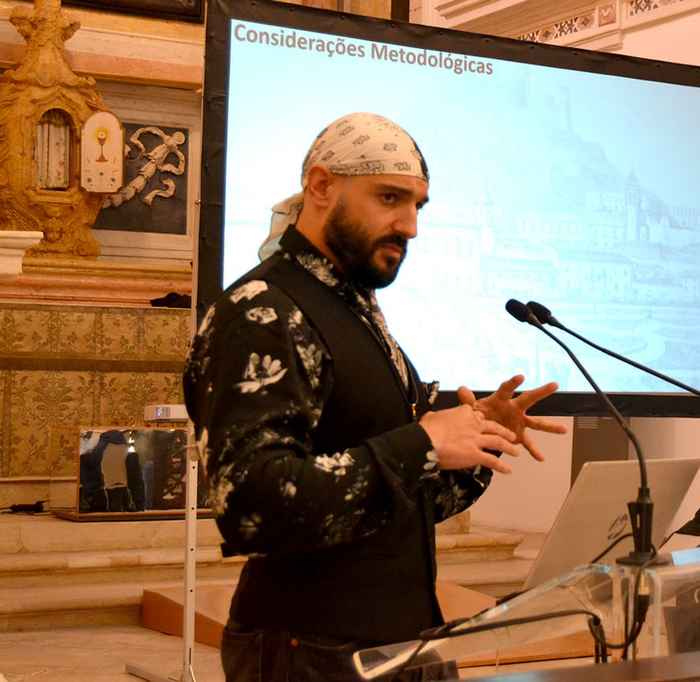
José Vieira Leitão has a PhD in Experimental Physics from the Delft University of Technology (2014) and Modern History from the University of Coimbra (2024). He is currently a contributing researcher at Center for the History of Society and Culture of the University of Coimbra and a member of the European Society for the Study of Western Esotericism.
His current lines of research focus on the mapping of both learned and folk magic in the Iberian cultural and geographic spaces, as well as other expressions of esoteric practice and thinking. This includes the search for local magic and esoteric texts in Portuguese and Iberian archives and understanding their relationship with wider European culture. He has authored several annotated translations of literary works related to magic and/or religious heterodoxy.