Lecture 'Christian-Muslim Entanglements in the Arabic Occult Sciences' by Salam Rassi
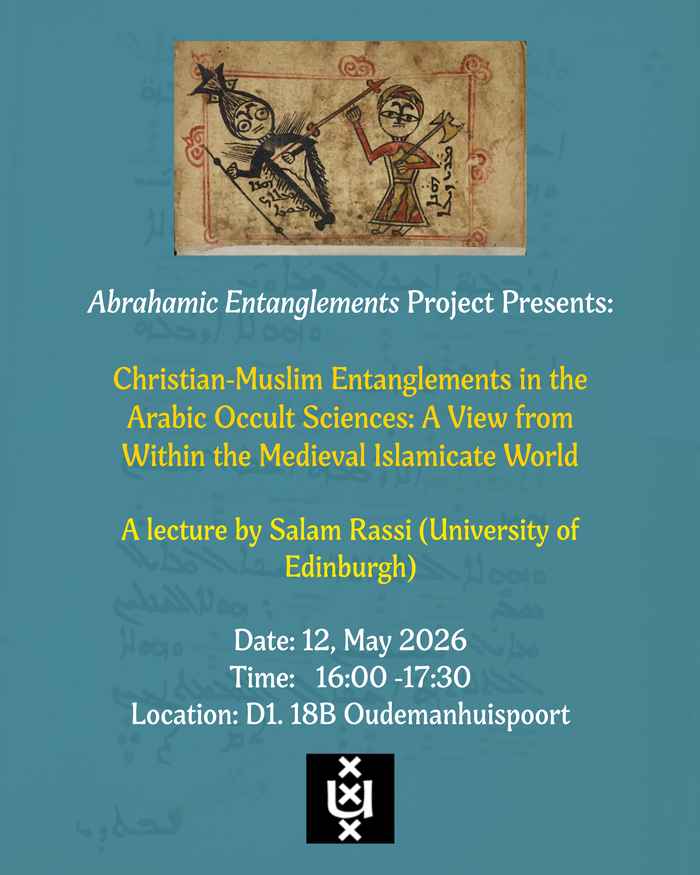
Christian-Muslim Entanglements in the Arabic Occult Sciences: A View from Within the Medieval Islamicate World
- Date
- 12 May 2026
- Time
- 16:00 -17:30
- Location
- Oudemanhuispoort
- Room
- D1.18B
We are delighted to welcome Salam Rassi (University of Edinburgh), whose research examines medieval Christian intellectual life under Islam. He is the author of Christian Thought in the Medieval Islamic World (OUP, 2022), a study of ʿAbdīshōʿ of Nisibis (d. 1318) and Christian apologetics in Arabic and Syriac. His work also explores the occult sciences as a site of Christian-Muslim exchange, including alchemical writings attributed to ʿAbdīshōʿ.
He will present on “Christian-Muslim Entanglements in the Arabic Occult Sciences: A View from Within the Medieval Islamicate World”.
Abstract: Christian-Muslim Entanglements in the Arabic Occult Sciences: A View from Within the Medieval Islamicate World Salam Rassi (University of Edinburgh)
Historians have long been aware of the transmission of Arabic occult knowledge to the world of Latin Christendom. Far less well understood, however, are the encounters between Islam and Christianity within the domain of occult science inside the medieval Islamicate world itself. The role of Christians in the so-called Translation Movement of Abbasid Iraq is well documented. Thanks to accounts such as Isḥāq ibn Ḥunayn’s Risāla and Ibn al-Nadīm’s Fihrist, we have substantial information about who translated Greek philosophical and medical works into Arabic and about the intermediary role Syriac sometimes played. The situation is markedly different, however, when it comes to the occult sciences. Here, reliable evidence for how these works were translated, by whom, and when is exceedingly scarce. What we find instead are a series of pseudo-epigraphic works in Arabic presented as translations from Greek or Syriac. These are often prefaced by stories featuring monks and priests in possession of arcane knowledge who place it at the disposal of Muslim rulers, or by accounts describing the discovery of occult treatises in monasteries, churches, or abandoned buildings.
Focusing on alchemical writings, this paper argues that these topos-laden narratives reveal little about the actual historical transmission of the occult sciences. Instead, they speak volumes about how Muslim authors imagined their diffusion in Islamicate lands. Drawing on the image of Christians as exemplary translators, these texts reproduce a recurring literary pastiche that persisted well beyond the Abbasid period. Such a study reveals that Syriac- and Arabic-speaking Christians themselves were aware of these stereotypes and occasionally deployed them in their own writings. In doing so, these authors sought to centre their own communities in the transmission of alchemical knowledge to Muslims—sometimes at the request of imams, emirs, or caliphs seeking the Philosophers’ Stone. Attention to such themes provides insights into how Christians living in the medieval Islamicate world positioned themselves within the history of science.
My focus will be on the pseudo-Aristotelian Epistle on Alchemy (Risālat fī l-ṣināʿa), prefaced by ʿAbdīshōʿ, a Church of the East bishop of Sinjār (d. 1318), who purports to have translated it into Arabic from an ancient Syriac vorlage. Upon close examination, however, the work proves to be largely indebted to Arabic models of alchemy, particularly those emerging from the writings of Jābir ibn Ḥayyān and Abū Bakr al-Rāzī. Yet, rather than reducing such works to their sources and influences, I argue that we should read translation as a literary motif, not a historical conduit—one shared by Christians and Muslims living in close proximity.