11th Eye International Conference - The Future of Film Programming
- Start date
- 31 May 2026
- End date
- 1 June 2026
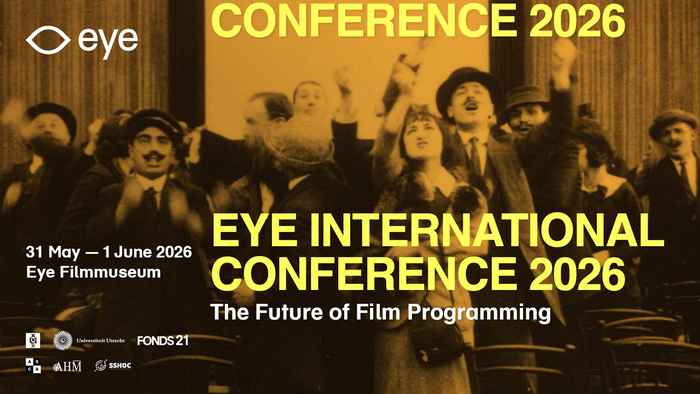
Over the last eleven years the Eye International Conference has become a meeting point for scholars, archivists, curators, programmers, film heritage professionals, filmmakers, students, artists, and film enthusiasts from across the globe to explore contemporary professional and academic issues affecting the field of audiovisual heritage.
2026 marks the conclusion of Programmers of the Future, a traineeship at Eye Filmmuseum that has supported the next generation of film programmers. The traineeship has, over the past five years, offered young professionals the chance to learn on the job while responding to the changing realities of audiences, curators and programmers, and cultural practice.
We take this opportunity to focus the upcoming Eye International Conference on the ways film programming, film heritage, and collections connect to respond to changing technological, political and socioeconomic landscapes. We particularly welcome critical perspectives that bridge different fields, considering how cross- and interdisciplinary approaches can inform, support, and strengthen one another.
We are looking to explore the following themes, while emphasising that the questions and topics listed here are neither exhaustive nor limiting, but meant as seeds of inspiration - we are equally interested in their interactions, cross-flows, and undercurrents. We encourage proposals from around the globe, especially from participants, archives, regions, and topics that are underrepresented in conferences related to audiovisual heritage and presentation.
1. Defining Film Programming Today
What does film programming mean today, and who defines it? From year-round to festival programming, we welcome reflections on the changing roles of programmers across institutions, collectives, and communities. How do power, authorship, and consent influence (co)programming on a global and local scale? How does film programming, as a concept and practice, relate to what is now often called film curating, and what is at stake? How do collections, mediation, and audience work shape meaning? We also invite perspectives on hybrid and site-specific forms (expanded cinema, presentations in gallery spaces, and exhibitions, etc.) and what kinds of limitations and affordances they have. How may transparency and shared authorship redefine curatorial practice and authority?
2. Access: From Prints to Platforms
We view film collections as dynamic spaces of co-creation rather than static archives. We invite proposals that explore how research and programming inform one another, and how access (whether logistical, legal, technical, or cultural) shapes the future of film presentation. How do cultural, ethical, economic, and technological concerns, as well as power, shape the choice and possibility of how films are mediated (analog or digital)? Case studies on non-canonical, regional, or global cinema, as well as on the material, environmental, and institutional conditions of access, are welcome. How do digital tools and methods expand reach? How can documentation and preservation practices help future-proof programming work?
3. Expanding Global Film Histories
We seek reparative, (trans)national, and decolonial approaches that challenge canonical histories and reactivate hidden or neglected narratives through programming. How can programming function as historiography, re-reading collections and mobilising community memory? How can programming actively challenge and reshape the canon? How can we overcome the challenges posed by the uneven global geopolitics of archives and collections, while avoiding epistemic extractivism and the reproduction of colonial or power relations? We welcome examples that bridge archival and social contexts, as well as re-engagements with historical programming strategies.
4. Engaging Audiences
We encourage explorations of how programming and film heritage can engage broader and more diverse publics. How might new audience understandings and participatory practices reshape the social role of film exhibition? And how can programming practices serve as forms of community-making or collective care? We welcome reflections on outreach and impact, as well as on how technological tools (DCP, HDR, VR, web-based projects, community platforms) and community-based methods can expand audience experience and access. This also includes programming beyond traditional screenings, including discursive programmes (talks, seminars, workshops) and exhibiting films outside cinemas. We are particularly interested in initiatives that reach audiences who are not regular festival or institution attendees, and in curatorial approaches that bridge linguistic and cultural gaps across diverse and multicultural communities. What strategies and considerations come to play?
5. The Profession’s Future
We invite reflections on sustaining the profession amid precarity and transformation through mentorship, fair labour practices, and new forms of (re)skilling in areas like archival literacy, accessibility, and AI. How do we negotiate professionalisation in times of job scarcity and financial precarity, alongside mentorship and training pipelines, and the pursuit of fair pay and equitable labour practices across festivals, cinemas, and archives? How can we break out of financial models that create uncertainty and job insecurity? How can emerging and alternative models (cooperative, online, or pop-up) reshape the field? We welcome comparative insights from training and pedagogical initiatives, and critical perspectives on programming as institutional critique.
Presentation formats
We welcome presentations in a wide range of formats, including the following:
* Report or Paper Presentation. 15 minute report/paper presentation.
* Panel. A 60-minute session consisting of a panel of 3-4 individuals who discuss a variety of theories or perspectives on a given topic. Panels consist of 45 minutes of presentation with 15 minutes of Q&A. Proposals in this category ideally include a facilitator who moderates the discussion.
* Show-and-tell. A 10 minute short presentation of a case study or archival material.
* Roundtable Discussion. A maximum 45 minute session of informal presentations on a general subject area, where participants share what they know. Proposals in this category ideally include a facilitator who moderates the discussion.
* Screening Session. A 45 minute presentation which includes a screening. The session may include speakers/discussion but the main portion of the presentation should be the screening.
* Artistic Interventions/Performative Lecture. A maximum 30 minute presentation/performance. The session may include speakers/discussion but the performance/intervention portion should take up most of the session time.
Important information
-> The programme committee may discuss with presenters appropriate alteration of a format or duration when this makes curatorial sense for the programme as a whole.
-> We are able to accommodate a number of live streamed or pre-recorded video presentations by speakers who may be unable or choose not to travel.
-> The conference will likely be recorded for live streaming, online sharing through Eye’s platforms, and archiving in Eye's collection for posterity. By submitting a proposal you agree to this.
-> All proposals must be sent in English. However, there is a possibility to accommodate presentations in other languages, for example in the form of a pre-recorded video with English subtitles, this should be clearly requested by prospective speakers in their proposals.
How to apply
You can submit your proposal online at www.eyefilm.nl/conference.
A proposal should include the following:
*A description (400 words) for the reviewers with information about the topic and why the session is important to be included in the programme. It should also identify AV materials by title, format, and duration.
*An abstract (150 words) that will appear in the conference programme and online if your presentation is accepted.
*A short bio (50 words) for each speaker.
*Images, if available (Copyrights must be cleared).
*Image captions.
*Screener (only applicable for screening session proposals).
Deadline
14 December 2025 (23:59 CET).
Results
Applicants will be notified about the decision of the Programme Committee around the 27th of February.
Registration
It is compulsory for all speakers to register for the conference. The cost of registration will be set between 50 - 100EU. Speakers can apply for one of the limited number of travel grants available.
Travel Grant Programme
Eye has a travel grant programme available for accepted speakers*** of the Eye International Conference. The grants, up to €500 each, can be used to partially offset registration and travel costs by way of reimbursement. To apply, please submit a brief letter of motivation (no more than 500 words) addressing the financial need for the award, as well as how your presence at the conference will contribute to your professional development. Please make sure to inform us of where you will be travelling from. Students and precariously employed individuals will be given priority. Email your application by January 15, 2026, to conference@eyefilm.nl, using the term ‘Travel Grant’ in the subject header.
***Please note that you are expected to send in your Travel Grant application before you receive the official notice of whether you are an accepted speaker.
Schedule
The Eye International Conference 2026 will take place in Amsterdam, from Sunday 31 May to Monday 1 June, with an opening programme on the evening of Saturday 30th May.
Programme committee
● Maral Mohsenin (Eye)
● Julian Ross (Eye)
● Eleni Tzialli (Eye)
● Giovanna Fossati (Utrecht University)
● Ari Purnama (Utrecht University)
● Floris Paalman (University of Amsterdam)
● Christian Gosvig Olesen (University of Amsterdam)
Advisory Board
● Alicia Abieyuwa Bergamelli
● Erika Balsom (King’s College London)
● Matthew Barrington (Barbican Centre/Birkbeck University)
● Carine Bernasconi (Cinémathèque Suisse/Université de Lausanne)
● Kseniia Bespalova (University of Groningen)
● Greg de Cuir Jr (Kinopravda Institute)
● Farah Hasanbegovic
● Pablo La Parra Pérez (Filmoteca de Catalunya)
● Luis Raguá (Cinemateca de Bogotá)
● Oksana Sarkisova (Blinken OSA Archivum, CEU)
Eye International Conference is organised by Eye Filmmuseum with the University of Amsterdam (UvA) and Utrecht University (UU). This edition is generously supported by Fonds21 within the context of the Programmers of the Future traineeship programme. Eye International Conference is supported by the Amsterdam School for Cultural Analysis (ASCA), the Amsterdam School for Heritage, Memory and Material Culture (AHM), the Institute for Cultural Inquiry (ICON) and Social Sciences and Humanities Open Cloud (SSHOC-NL).
For more information: www.eyefilm.nl/conference, email: conference@eyefilm.nl