Is Fairer Communication Possible through Esperanto?
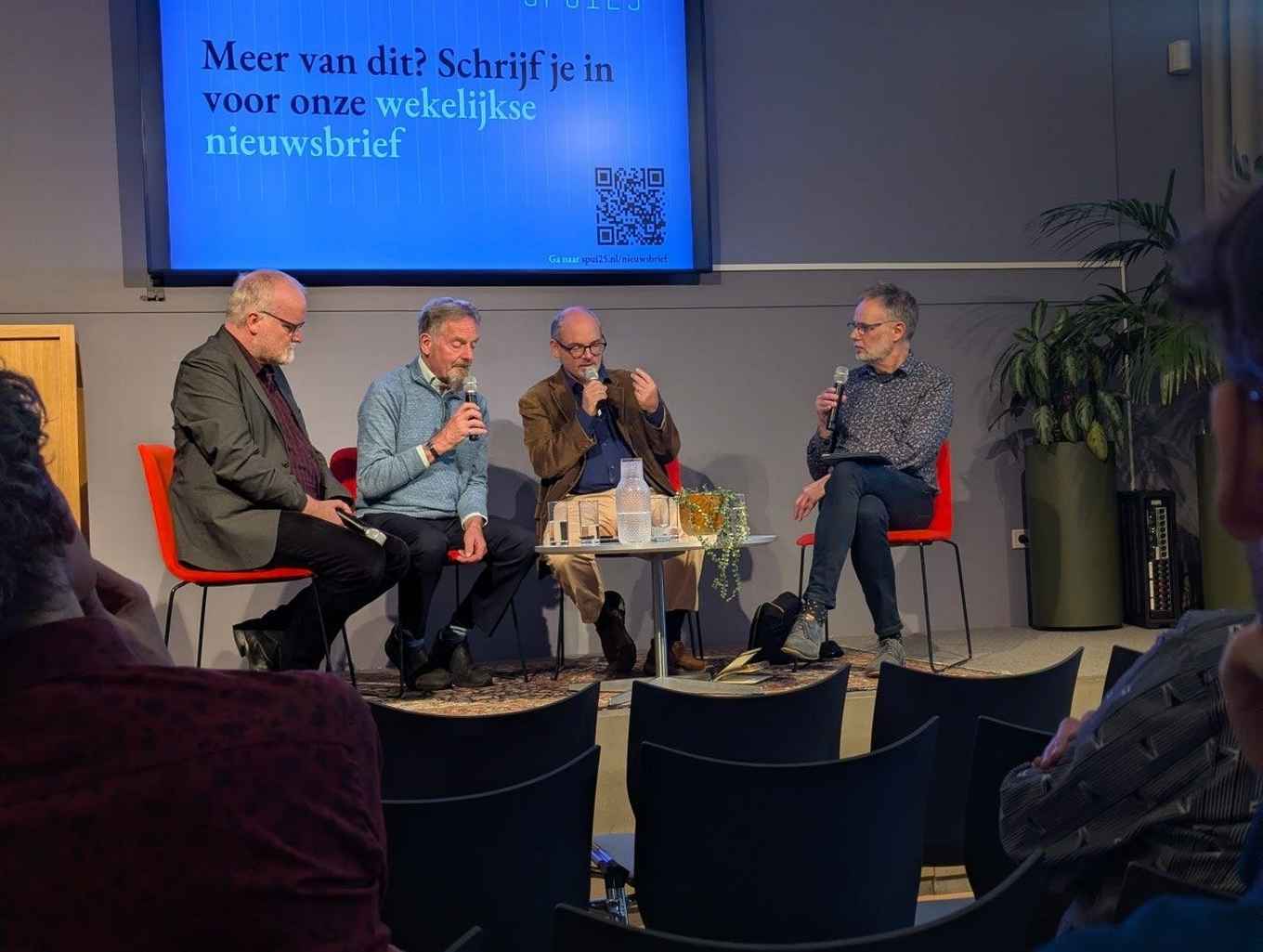
Federico Gobbo (UvA) and Marc van Oostendorp (RU) debate the possibilities of an alternative world order during an ACLC event at SPUI25, Amsterdam — Thursday 15 October 2026, 17:00.
9 November 2026
Global Communication Not in English
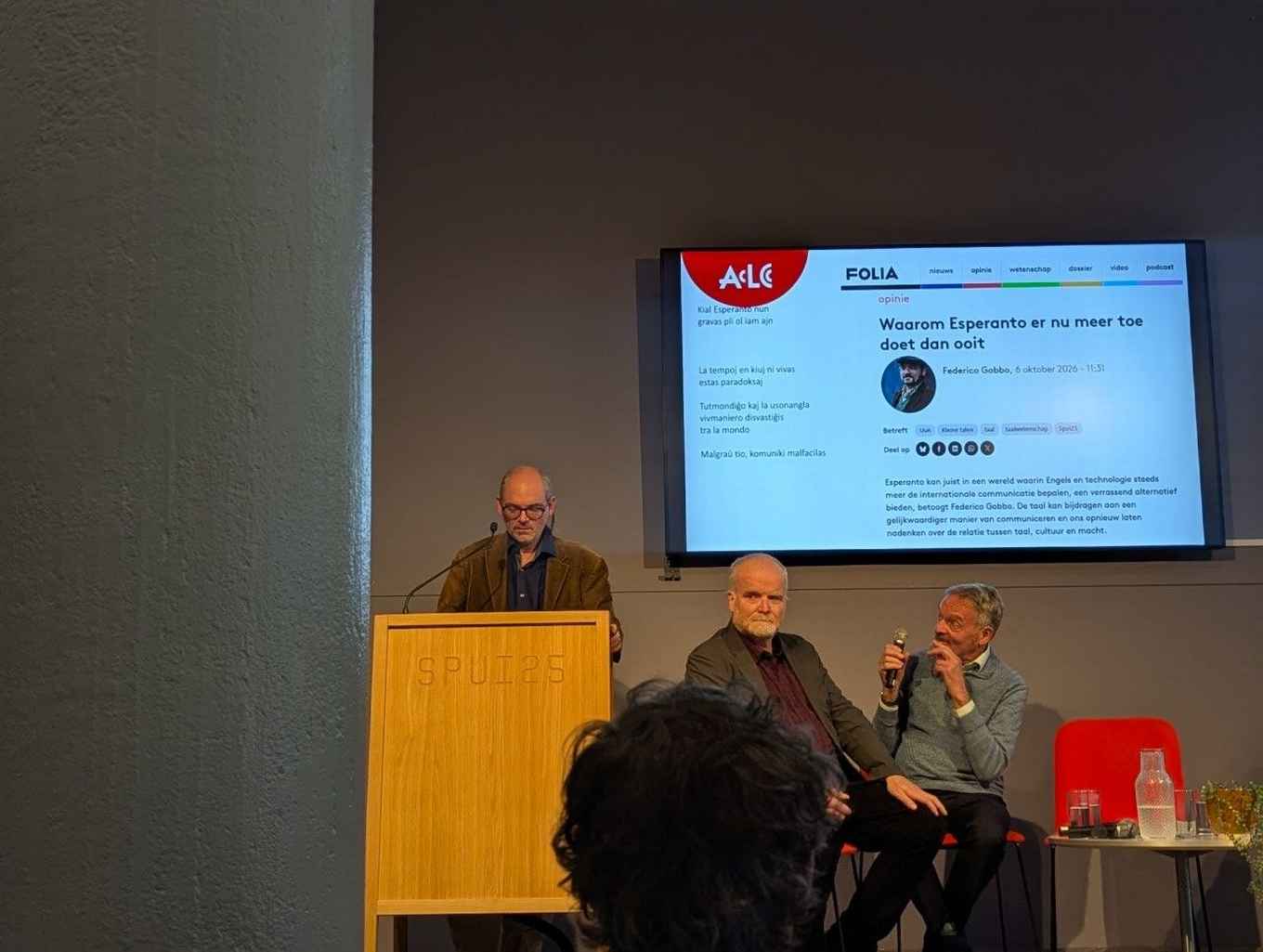
On Thursday 15 October, the ACLC sponsored an event initiated and organised by Federico Gobbo, full professor on the Special Chair of Interlinguistics and Esperanto at the University of Amsterdam, established on behalf of the Universala Esperanto-Asocio. He spoke in Esperanto, while Bert de Wit, a well-known Esperanto-community activist and translator, interpreted into Dutch. The debate was with Marc van Oostendorp, professor of Academic Communication at Radboud University Nijmegen, editor of neerlandistiek.nl, lifelong Esperantist, and former Chair Holder of Interlinguistics and Esperanto at the University of Amsterdam in the 1990s. Gaston Dorren, a Dutch language journalist and author (Lingua, Babel, Zeven talen in zeven dagen), framed the session. He started it as a friendly skeptic: personally, he finds Esperanto "a beautiful idea and a beautiful language," but he wanted the experts to convince him — and the audience — of its merits. Thus, English was deliberately excluded as a working language for the whole event, even though all speakers were fluent in it.
The Importance of Esperanto at the University of Amsterdam
This year marks 75 years of Esperanto instruction at the University of Amsterdam, said Gobbo in his introduction. He traced the lineage: Sigismundo Pragano (1907-1966), a WWII survivor in the city, who became professor of Rumanian language and literature in 1951 and also taught Esperanto; Adriana J Middlekoop (1913–2009), famous for her Prisma Woordenboek Nederlands–Esperanto (1971), who taught from 1969; Rob Moerbeek, (1936–2025), recipient of the Order of Orange-Nassau and the last "private docent" of Esperanto at the university, who died recently; then the formal Chair, held first by van Oostendorp, Wim Jansen, who also passed away, and now by Gobbo himself since 2014. Esperanto is even named on the building's facade of the new University Library Building, among all other languages taught at the university.
Esperanto Filling an Identity Gap
Citing research by his partner, psychologist Valeria Pierdominici, Gobbo argues that for people with mixed backgrounds or multilingual lives, Esperanto can fill an "identity gap"—metaphorically, an instrument for navigating life. The interview (in Esperanto, English, and Italian) that illustrates the concept appeared on a well-known Esperanto podcast, Varsovia Vento (Warsaw Wind).
AI does not level languages
From Gobbo’s roundtable experience in Sarajevo with Bosnian, Croat, and Serbian participants, it is clear that even languages with small digital archives, such as Bosnian, fare worse in AI systems than languages with more data. AI therefore creates a new hierarchy between languages, based purely on available data, often mirroring their power outside the digital sphere. In this sense, Esperanto is an exception: even if it is definitely not a language of power, its online presence is relatively high because of its community of practice. More generally, we cannot trust corporations in the AI market to self-regulate their products; instead, governments should shoulder this duty, as the recent Madrid Manifesto for Responsible AI declared, calling on all stakeholders to take a stance.
The ideal of a neutral language
Van Oostendorp dissected the concept at the heart of Esperantism: the language ideology that Esperanto is a neutral language. In a nutshell, Esperanto is a language in which nobody has an inherent advantage speaking it. Zamenhof's founding vision (from his speech opening the first world congress in 1905) remains moving. Who speaks Esperanto does not meet the others Russians with Poles or Frenchmen with Englishmen, but “as human beings with human beings." Yet that equality was conceived among Europeans, and Esperanto's vocabulary is largely recognisable from European languages (German, Latin, French, Russian, etc.).
We should then distinguish, van Oostendorp argued, two kinds of neutrality: structural and sociological. Structural neutrality, that is, conceiving language as equally easy for everyone, is probably impossible. Even word order forces an arbitrary choice, and restricting the sound inventory to evade accent problems (few vowels and consonants) would force absurdly long words. On the other hand, sociological neutrality, that is, the idea that no group experiences the language as "theirs”, is not unique to Esperanto. History offers partial successes: Indonesia chose Malay (Bahasa Indonesia) over the majority language Javanese; Tanzania promoted Swahili under Nyerere ("the language of a nation, not of one people"). Nonetheless, these languages tend to drift toward ownership: native speakers emerge, norms of "good" usage arise, and an elite forms. Latin was nobody's mother tongue and thus ethnically neutral — yet the language of a tiny, heavily schooled elite. Even Erasmus, a non-Italian, became a towering Latin stylist: no ethnic advantage, but a strong class and education advantage.
Zamenhof understood this risk and tried to freeze neutrality structurally: authority in Esperanto rests not with native speakers but with a book — the Fundamento de Esperanto. This strikingly liberal text fixes what counts as correct Esperanto in a few general rules, not to be overcome, while leaving plenty of freedom for language development. Yet the deeper sociological drift remains unsolved; even Esperanto now has so-called native speakers ("denaskuloj"), even if they hold no special authority on the language, and idioms beyond the Fundamento (such as fina venko, "final victory").
The costs of a non-neutral language
A recent study in biology publishing found that non-native English speakers need about twice as long to read or write a paper and are rejected ~2.5 times more often—cited as inherently unfair, van Oostendorp reported. But science is not the only domain where inequality caused by a non-neutral language such as English dominating the scene is clear, to the point that it has even been calculated. François Grin's 2005 calculation shows that English dominance yielded the UK roughly €17–18 billion per year within the EU—a transfer from other member states. Ironically, post-Brexit UK still profits from English's EU-wide status (Malta and Ireland keep it official) while contributing nothing. The "native-speaker premium" persists informally: EU institutions formally dropped the requirement that staff be native English speakers, but job ads still imply it; even established academics still receive requests to have manuscripts checked by native speakers. A telling anecdote: the Zelensky–Trump Oval Office exchange, where Zelensky's hard-won English gave him no parity with native speakers.
Two remedies were proposed for this imbalance. Philippe van Parijs proposed compensating directly, ideally with the anglophone world funding English-language schooling worldwide. But would the result be fairer? Organising international communication differently, which is precisely what the Esperanto movement keeps proposing since its foundation in 1905.
The other remedy proposes AI as a neutral hearing aid: everyone speaks their own language; for instance, an earpiece translates in real time into your language with your interlocutor's voice. The idea is attractive in principle, but not neutral in practice. ~42% of web text is English; Dutch is maybe 1.5–2%; Swahili, a language spoken by tens of millions, is ~0.01% — so minority languages are badly underserved and translations often pivot through English. On this point, Gobbo and van Oostendorp agree. Moreover, a handful of companies run AI, using opaque algorithms nobody fully understands. Experiments showing models with slight political biases invisibly shifting users' own later positions (users denied being influenced) make it wary of hidden bias in translation too. Some of this could be fixed (public, collectively owned systems), and his conclusion was carefully balanced: he sowed real doubt that a fully neutral language can exist — but the world demonstrably needs something like one.
In Esperanto your passport, origin, ethnicity, social class, gender do not matter so much: the openness and respect of the Esperanto culture make the newcomers feel welcome and accepted for who they are as individual human beings, not as part of some other human grouping.Federico Gobbo
Open issues on the feasibility of Esperanto
Asked how Zamenhof's knowledge of 10 languages shows up in Esperanto, Gobbo answered layer by layer: French dominates the vocabulary (French was then the international language); structure and syntax reflect Germanic and Slavic patterns; Esperanto's agglutinative word formation resembles Hungarian, Finnish and Turkish — languages Zamenhof did not know; the morpheme paradigm may even show Hebrew influence. Thus, even if Esperanto is culturally eurocentric, as its vocabulary certainly is, its structure sits at the periphery of the European prototype.
Asked whether Esperanto speakers from Europe, China and India would struggle to understand each other's accents (as in English), van Oostendorp replied that the decisive factor is sociological instead of phonetic: the Esperanto community's strong desire to understand each other does the work — comparable to sign-language users, who understand each other more easily across varieties.
On the Esperanto community’s aspirations and desires, Gobbo stated that virtually no Esperantist today believes in the literal fina venko; the movement's current tendency is that "the world order begins with the individual" — change starts with oneself, living an alternative internationality, so speakers can compare the other international lives they have, above all, the one in English. Unlike the latter, in Esperanto your passport, origin, ethnicity, social class, gender, and so on, do not matter so much: the openness and respect of the Esperanto culture make the newcomers feel welcome and accepted for who they are as individual human beings, not as part of some other human grouping.
Gobbo concedes that Esperanto belongs to its speakers, and idioms prove that. On the other hand, Esperanto's metaphors are produced by its speakers, not inherited from a single culture. For example, the meeting-place expression "at the nose of the train", was coined spontaneously by Japanese Esperantists and adopted worldwide effortlessly.
Grin's figure was contested by an audience member, who noted that €18 billion is under 1% of UK GDP, and Brexit cost the UK ten times more — perhaps a spontaneous compensation. Van Oostendorp conceded the point partially: Grin's figure covers only the EU; we should not forget that the native-speaker-norm premium (now informal, but well alive), still exists, which is the real sticking point.
A question concerned the 140-year-old recruitment problem: how does Esperanto gain ground without power or economics behind it? Both speakers acknowledged the collective-action trap (people invest only when enough others do — Zamenhof's own pledge coupons anticipated this). They likened Esperanto to aspirations like peace or ending hunger: pursued without expectation of completion. Dorren noticed that Esperanto means "one who hopes" — and that, unlike waiting for revolution, you can meanwhile just enjoy speaking it.
Another objection referred to the elite capture risk. If Esperanto ever did triumph, wouldn't it become an elite language like English in India? Gobbo pointed to its structural learnability (fast to learn for Europeans; learners in East Asia face more work, yet communities there exist), while van Oostendorp admitted fluent speakers would still constitute a "better Esperanto" elite — but argued this is a general problem of education, not specific to any language, solvable only by equitable schooling worldwide.
By the end, the elephant in the room was pointed out: is Esperanto a threat to language diversity? In other words, if everyone spoke Esperanto as a second language, why keep first languages? Gobbo answered with the movement's post-WWII evolution: modern Esperanto congresses actively celebrate the local language (e.g., a recent congress in Catalonia featured Catalan), and the Esperanto community shares traits with minority-language communities, fostering solidarity rather than replacement. Van Oostendorp agreed the danger is real but generic — the solution is making people comfortable with multilingualism per se.
Personal stories in learning Esperanto
By the end, the moderator invited the speakers to share their initial motivation for learning the language. Van Oostendorp learned it as a teenager from a library course ("nuclear power? No thanks" printed on the cover), and it was Bert de Wit who corrected his exercise via correspondence; de Wit learned via the radio and 1960s democratisation ideals of the 1960s; for family reasons, Gobbo saw borders between European countries as artificial, and as a BA student he became a European federalist — integrating Zamenhof’s idea of the United States of Europe with Esperanto as a federal language. He then learned the language at the University of Turin, where he was studying at the time, to test whether the language was robust enough for such a purpose.
Fairer communication matters
The evening delivered what its subtitle promised: a sober, well-evidenced inquiry rather than advocacy. On the one hand, English's structural unfairness is quantifiable and real (Grin; the biology publishing study; the native-speaker premium). On the other hand, a genuinely neutral language is, on the evidence presented, probably unattainable — linguistic structure, sociology and technology each reintroduce hierarchy in different guises. Yet both speakers agreed that the search matters: alternatives deserve continued thought, and Esperanto—small, imperfectly neutral, but alive and culturally creative—remains the most serious institutionalised experiment in fairer international communication to date.