'The community you find here is warm, intellectually generous, and genuinely inspiring'
Dr. Regina Mantanika on her Marilena Laskaridis visiting fellowship
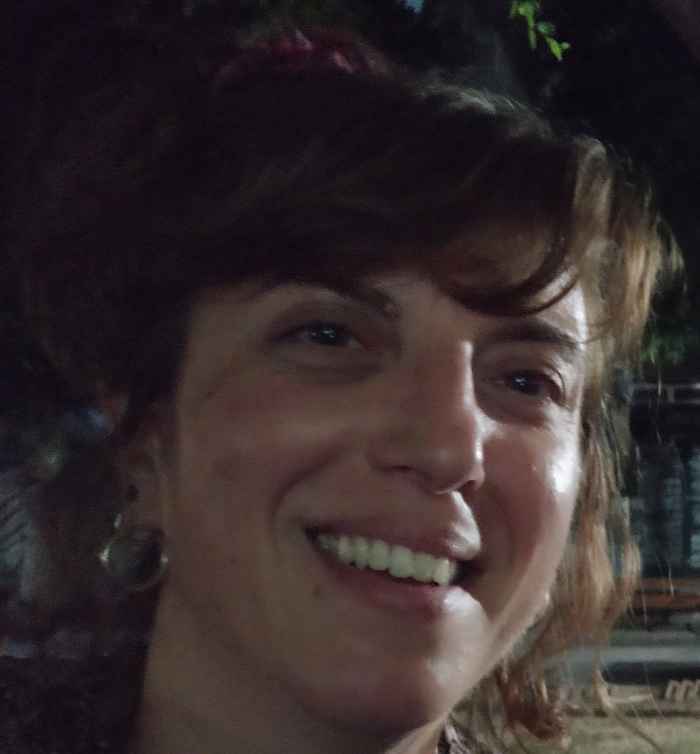
Can you tell us a few things about the project you worked on during your Laskaridis Research Fellowship at the University of Amsterdam?
During my Marilena Laskaridis Visiting Fellowship, I worked on two interconnected strands of research. The first was the preparation of a short monograph on Eleusina, approaching deindustrialization not as a linear process of decline but as a layered and ongoing transformation shaped by overlaps between industrial closures, new forms of production, and spatial reorganization. By tracing the vocabularies used to describe industrial decline and transformation in the Greek context, the project situates Eleusina within broader debates on deindustrialization, industrial legacies, political economy, and cultural studies, particularly through attention to industrial memory, representation, and the cultural meanings attached to post-industrial landscapes, while also questioning the Eurocentric assumptions embedded in dominant theories of deindustrialization. The second thing I did, which is closely related to the first, was to begin developing ideas for a proposal for a Marie Curie postdoctoral fellowship that I hope to bring to the University of Amsterdam. Building on my previous work in Eleusina, this project expands comparatively to other Greek cities such as Patras and Volos, and potentially to deindustrialized regions in Spain and Morocco. The goal is to explore shared post-industrial trajectories across the wider Mediterranean and develop a broader comparative framework for thinking about industrial transformation, cultural imaginaries, and post-industrial futures.
How does your work relate to Modern Greek Studies, broadly understood, and how do you see your connection to the field?
My work relates to Modern Greek Studies through its engagement with modern Greece as a site for thinking about questions of industrial culture, memory, and spatial transformation. My research resonates with a broad understanding of Modern Greek Studies as an interdisciplinary field that brings together history, culture, politics, and critical theory, while also connecting to the Mediterranean and transnational frameworks emphasized at the University of Amsterdam. I see my connection to the field precisely in contributing to this expanded and outward-looking understanding of Modern Greek Studies—one that includes cultural studies perspectives, comparative Mediterranean approaches, and critical interventions that situate Greece in wider regional and global debates.
How did you experience the academic environment at the Humanities Faculty of the University of Amsterdam and within the Modern Greek Studies community at our university? What did you enjoy most about your time in Amsterdam?
The Modern Greek Studies team creates an atmosphere that is genuinely welcoming—the kind of warmth that makes you want to stay connected to the department long after your fellowship ends. But the broader intellectual environment of ASCA (Amsterdam School for Cultural Analysis) was equally significant: it became a real source of inspiration, pushing me to open up my research to different analytical registers and disciplinary conversations beyond those I usually navigate. The flexi room in the P.C. Hoofthuis that gradually turned into a kind of permanent office with the ASCA crew helped build a lovely small community—one of those organic things you don't plan but end up valuing enormously.
The department's location in the city centre is an asset itself. The spontaneous walks down Spuistraat, the back-and-forth to the new library through the red light district—it pulls you into the city and into its layered, fascinating history in the most effortless way.
But what I will carry with me most is the people. The Modern Greek Studies team and the ASCA ‘Crisis, Critique and Futurity’ Reading Group—which emerged from the Modern Greek studies team and brings together a broad community of past and present fellows, doctoral students, and other senior and junior researchers in the Netherlands and beyond—felt like something genuinely special. The hybrid community of the "Omsterdommers" is somewhere between a group of colleagues and a family. Getting to know Maria Boletsi and the beginning of what I already sense will be a strong bond; Tatiana Markaki, Eva Fotiadi, Despoina Moysiadou, Carl Mauzy—people who made the whole experience feel complete and, in the best possible way, genuinely interesting, and Yiorgos-Evgenios Douliakas, with the walks and various events in Leiden and elsewhere, who brought a wonderful wider network into the picture. Finally, Amanda Kubic—my co-fellow, holder of this year’s second Laskaridis fellowship—with whom, despite the brief overlap in our “residencies”, I managed to forge the beginning of a real connection. The connection I found here, in such a short time, was something I genuinely didn't see coming!
What do you see as the main take-away from your fellowship and how do feel that the fellowship contributed to your future plans? Do you see yourself returning to Amsterdam in the future?
The fellowship gave me the opportunity to get to know the work of colleagues at the Modern Greek studies program and beyond in ways that genuinely enriched the project I am currently developing. In terms of concrete next steps, I am preparing a Marie Curie application that I would very much like to bring to Modern Greek Studies and the Marilena Laskaridis Chair and to ASCA, potentially in collaboration with the Department of Social and Cultural Anthropology at VU Amsterdam and/or the Department of History at Utrecht University. The fellowship was instrumental in making these connections feel natural and grounded—it gave me a real sense of the research landscape here and of the colleagues I want to work with.
Alongside the Marie Curie, I am also planning to apply for smaller fellowships with the specific goal of spending more time at the department. I am very much hoping to return, and not just once. Beyond the research, there is a community here—an extended group of people—that I very much want to find my way back to.
What advice would you give to prospective applicants for the Laskaridis Research Fellowships?
The Laskaridis Fellowship is a very special kind of pause—in your work and in your life. It gives you the space and the people to think, to reconnect with your research, and to build connections that go well beyond the fellowship itself. The community you find here is warm, intellectually generous, and genuinely inspiring. Come with an open research agenda, be ready to be surprised, and make the most of everything it has to offer—the conversations, the seminars, the city, the people!