'I had an excellent experience within the academic environment of UvA'
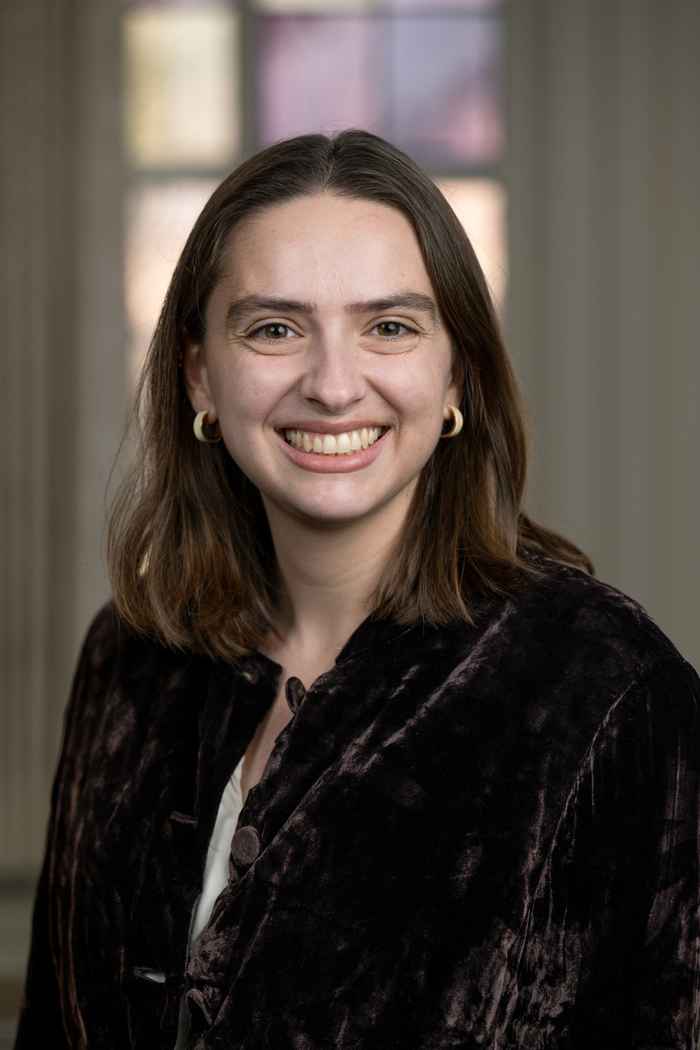
Could you briefly tell us about the project you worked on during your Laskaridis Research Fellowship at the University of Amsterdam?
Throughout my Laskaridis Fellowship term at the University of Amsterdam, I worked on my project “Choreographing a Modern Greek Nation: Koula Pratsika, ΚΣΟΤ, and their Afterlives.” Through a series of lectures in London, Amsterdam, and Shanghai, as well as a workshop on my article-in-progress hosted by ASCA’s “Crisis, Critique, and Futurity” reading/research group, I was able to develop my research on the twentieth-century Greek choreographer Koula Pratsika, various performances over the past century by her National Dance School in Athens (Η Κρατική Σχολή Ορχηστικής Τέχνης or ΚΣΟΤ), and her collaborations with other renowned dancers and choreographers, including Rallou Manou.
In one of my early lectures, I situated Koula Pratsika and Rallou Manou alongside the American modernist choreographer Martha Graham and the contemporary Greek choreographer Valasia Simeon in order to situate these women in a network of dance educators and practitioners who, when viewed together, shed light on the personal, political, and aesthetic ideologies that have informed the development of “Greek” dance since the 1920s. As my work continued to take shape over the course of my Fellowship term, I homed in on one performance that Pratsika and Manou co-choreographed in 1939, a “Water Celebration” (Η Γιορτή του Νερού) at the site of the Marathon Damn, to commemorate the ten-year anniversary of its completion. Through UvA’s library resources, I was able to locate and analyze photographs, reviews, and other written and visual material from the festival, which occurred under the authoritarian Metaxas dictatorship in Greece. I am now in the process of finishing an article on the intersecting (and sometimes contradictory) discourses of Hellenism, nationalism, and feminism that informed Pratsika and Manou's vision of a collective modern Greek identity and a new kind of modern Greek dance during this period.
How does your work relate to Modern Greek Studies, broadly understood, and how do you see your connection to the field?
My work is inherently interdisciplinary. I locate my current projects, including my research on Pratsika and twentieth-century dance in Greece, at the intersection of Modern Greek Studies, Comparative Literary and Performance Studies, and Critical Classical Reception Studies. Much of what I am interested in, broadly speaking, is how modern women in North America and Greece create poetry, choreography, and multimedia performance art that uses a classical Greek frame to interrogate bodily (non)normativity. That is to say, I explore how women artists from the past century draw on the literature, material culture, and legacy of Greek antiquity to perform queer/Black/racialized/and disabled (post)modern embodiments and body politics.
I find the comparison between modern Greece and North American particularly productive, as it allows me to see how Hellenism today is a simultaneously global and localized phenomenon. For example, while an American artist like Martha Graham makes ancient Greek tragic figures like Jocasta and Clytemnestra into universal archetypes in her mid-twentieth-century dances, archetypes that she believes can speak to basic shared emotions and experiences across all of humanity, Koula Pratsika tries to re-localize Greek history for Greek creators (and in particular, for Greek women), claiming a continuous Greek heritage by and for Greeks. In her choreography of a Greek national identity, Pratsika navigates between Greek folk traditions and neo-classical iconography made even more popular with the rise of fascism and authoritarianism in Europe in the twentieth century. Many of her dances are inspired by the imagery of archaic vase paintings and classical statuary. Yet despite their different claims to a Western universal vs. Greek national vision of Hellenism, both Graham and Pratsika make space for female creative agency and the professionalization of women in the fields of dance and dance education in their emergent schools. I give this example to highlight how the comparison between modern Greek and Anglo-American contexts allows me to ask how Greek women’s acts of revising and remaking the classical tradition carry a historical, cultural, and artistic significance that is different from the Anglophone tradition. In my other projects, I also raise questions about the practice and politics of translation—between ancient and modern Greek, between ancient Greek and English, and between modern Greek and English— as well as modern (de)constructions of whiteness and Blackness in relation to Greek antiquity, and crip/queer politics and aesthetics in both Greek and North American poetry and performance.
What was your experience of the academic environment at the University of Amsterdam, particularly within the Humanities Faculty and Modern Greek Studies?
I had an excellent experience within the academic environment of UvA and very much enjoyed getting to know the faculty and graduate students that I was fortunate to meet. I have been able to make many invaluable connections with people in and around UvA, which have enriched both my personal and professional life. It was a pleasure sharing an office with some of UvA’s PhD students in the Humanities, and I was able to have some fun conversations in and outside of the office about their research and their lives in Amsterdam. I was also so lucky to have Dr. Maria Boletsi as my friend and mentor during my time at UvA. Maria was so welcoming, kind, and generous, and I look forward to continuing both our friendship and our ongoing scholarly conversations about Modern Greek Studies as the years go on! It was also a privilege to be able to share my first month in Amsterdam with the previous Laskaridis Fellow, Dr. Regina Mantanika. Regina’s friendship and intelligence are extraordinary, and going to events with her such as the Rijksmuseum’s special exhibition on Ovid’s Metamorphoses was an absolute joy. It was also a delight to speak with Drs. Tatiana Markaki, Carl Mauzy, and Eva Fotiadi, and some of the Modern Greek Studies community in Leiden such as Yiorgos-Evgenios Douliakas about our shared interests in Greek poetry, performance, photography, film, and visual history. These are relationships that I will continue to treasure for a very long time.
While at UvA, I was also able to connect with faculty outside of Modern Greek Studies, including Dr. Bonnie Honig, the visiting Spinoza Chair in the Department of Philosophy at UvA, and Dr. Kati Röttger from the Institute of Theatre Studies. I was able to attend Dr. Honig’s lecture on Euripides’ Hippolytus in April and had a lovely conversation with her about our shared research interests. Likewise, I was able to meet with Dr. Röttger to discuss our shared work in performance and her recent book on intermediality in modern theater. In May, I went to an ASCA-sponsored workshop on “Speculative Media: Literature, Digital Story-Worlds, and Social Change,” where I was able to meet Dr. Steve Jankowski and author Ruthanna Emrys, as well as several graduate students working in the area of speculative fiction. I had so much fun at this workshop and really enjoyed getting to hear more about what other faculty and students at UvA were working on. I even tried my hand at writing a little speculative fiction of my own!
Were there any aspects of life in Amsterdam or at our university that you found surprising, unusual, or challenging?
Coming from a campus in the US where most of the academic buildings are centralized and set apart from town, it was an adjustment getting used to the way that UvA’s various buildings are spread throughout and integrated into the city. But I found that I quite enjoyed the opportunities to walk from PC Hoofthuis to the new University Library when I needed a book or a change of scenery, or to go from the west to the east side of Amsterdam, from Spuistraat to the Roeterseiland Campus, for different University events. This gave me a chance to see some more of the city during my usual workday, which was very much welcome. It was also exciting to see the different styles of architecture used for UvA’s campus buildings, from the modern glass and steel of PCH to the historic atmosphere of the Aula inside the Oude Lutherse Kerk.
I was also able to take advantage of UvA’s proximity to the University of Leiden by train (something else new for me!), and attended several events there such as a workshop and lecture by Dr. Lina Chordaki on “Archives, Social Movements, and the Temporalities of Knowledge” in the Greek birth control movement, and an “Avant Drag!” moviementary screening and discussion. It was a novel and wonderful opportunity for me to be able to hop on intercity transit to engage in these rich academic dialogues between campuses, and I was pleasantly surprised by the ease of getting from one campus to the other and by the high level of ongoing scholarly exchange between the two Universities.
What did you enjoy most about your time in Amsterdam—both at the university and in the city itself? Looking back, what stands out as the highlight of your fellowship?
The highlight of my time in Amsterdam would certainly be relationships I was able to form with my friends and colleagues at UvA, Leiden, and in Amsterdam more broadly. In a professional capacity, I benefitted so much from my ongoing dialogues with Drs. Boletsi, Markaki, Mauzy, Mantanika, and Fotiadi, and really value all the insight they were able to offer into the field and into my own work and theirs! For example, in an online discussion of my work with the “Crisis, Critique, and Futurity” research/reading group organized through ASCA and co-facilitated by Drs. Boletsi and Fotiadi, I presented a draft of my article-in-progress on Pratsika and Manou’s choreography for the 1939 “Water Celebration” at Marathon. I received some extremely helpful feedback on my work from those who attended the workshop, including suggestions to highlight the reparative and “liquid” nature of my reading of the performance, to comment more on how issues of socio-economic class presented themselves at Pratsika’s school, and to begin the piece with a modern modern performance speaking to similar themes around nation, womanhood, water, and myth.
But it was also such a pleasure to be able to go on museum outings in Amsterdam, the Hague, and Voorlinden with these same friends and colleagues, and to gather together for informal discussions and receptions after a lecture by Regina, for example, or a film screening by Yiorgos. These relationships, along with the work that I hope to eventually publish on Pratsika and modern Greek dance, will certainly be the main take-away from my fellowship experience, and I look forward to maintaining these conversations and collaborations in the future!
What are your plans for the next few years? Do you feel the fellowship contributed to these plans, and if so, how? Do you see yourself returning to Amsterdam in the future?
This fall, I am beginning a Postdoctoral Fellowship at the Seeger Center for Hellenic Studies at Princeton University. I have been appointed as the 2026-7 Edmund and Mary Keeley Postdoctoral Fellow and am very excited to continue my work in Modern Greek Studies, poetry and performance, and Critical Classical Reception studies at Princeton! I do hope that my path will bring me back to Amsterdam in the future, whether personally or professionally, and if only for a few days! I truly fell in love with the city during my time as a Laskaridis Fellow and would love to visit again someday.
What advice would you give to prospective applicants for the Laskaridis Research Fellowships?
I would advise future applicants to look into all of the wonderful resources UvA has to offer to scholars of Modern Greek Studies. In addition to the fabulous faculty, the library has a wealth of material just waiting to be accessed, and you might even stumble on some unexpected archives at the Allard Pierson Museum, or on some unexpected connections in UvA’s many reading and workshop groups. I found ASCA to be a wonderful space of connection to other scholars and disciplines at UvA and would encourage applicants to check out all the exciting conversations being had in the Humanities that might enrich their own research!