Hidden Films: Expanding Archival Perspectives
12th Eye International Conference 30 May – 2 June 2027 Eye Filmmuseum Amsterdam, www.eyefilm.nl/conference Deadline for submissions: 13 december 2026 (23:59 CET)
Event details from: Hidden Films: Expanding Archival Perspectives
- Start date
- 30 May 2027
- End date
- 2 June 2027
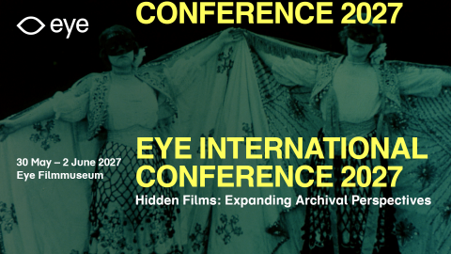
Over the last years the Eye International Conference has become a meeting point for archivists, scholars, curators, programmers, film heritage professionals, filmmakers, students, artists, historians, and film enthusiasts from across the globe to explore contemporary professional and academic issues affecting the field of audiovisual heritage. During its 12th edition themed “Hidden Films”, the conference will zoom in on how film archives preserve and uncover the audiovisual past in an inevitably fragmented and partial manner, and how silences, gaps and absences shape our understanding of this past. Some materials have never entered archival collections; others have been conserved but remain unseen, undocumented or inaccessible, while others have been deliberately hidden. How can we identify and address these absences and the processes they result from in meaningful ways? How can we study what has been left out, understand the conditions of its absence or obscurity, and work from incompleteness without seeking to restore an impossible totality? And how can we critically examine the histories constructed around the partial availability of archival material and reconfigure them?
The 2027 Eye International conference proposes to dive into these questions and welcomes new perspectives, research and screenings which can broaden our view. The goal is to reframe our perspectives on what archives contain, what they exclude, how these boundaries have been established and how they can be challenged. Films enter archives through different routes and carry different histories and receive different degrees of attention over time within archival and museum exhibition practices. Archival methods, policies, priorities and resources have changed throughout the years and shaped how collections are described, preserved and made accessible. Gaps in documentation, incomplete or inaccurate database records, and language barriers (including the inability to read other alphabets) further affect how materials can be understood and rediscovered. Looking at these from an interdisciplinary perspective, we also welcome historians, filmmakers, activists, and scholars to share their theoretical and methodological approaches, as well as their practical experiences in addressing these questions. How have these overlapping positions favored certain audiovisual histories over others, and what concrete social, political, technical or other factors have contributed to the marginalisation or erasure of others?
To these challenges are added the on-going development of film and audiovisual technologies. Within archival and filmmaking practices, these technical and technological changes offer new possibilities for preservation, description, access and reuse, but they also include inherent choices and biases that can create new gaps or perpetuate old ones. These limitations remain present in contemporary tools, including artificial intelligence. How have the new technologies historically modified the audiovisual archival landscapes when it comes to archival gaps and absences, and what futures do emerging technologies hold? Through this edition of Eye International Conference, we would like to explore both the challenges and possible new solutions, notably through decolonial and transcultural approaches, and consider collaboration with communities and individuals whose knowledge and perspectives have been overlooked.
I Programme committee
● Maral Mohsenin (Eye)
● Eleni Tzialli (Eye)
● Giovanna Fossati (Utrecht University) ● Nermin Elsherif (Utrecht University)
● Asli Özgen-Havekotte (University of Amsterdam)
● Christian Gosvig Olesen (University of Amsterdam)
● Luna Hupperetz (University of Amsterdam) Eye International Conference is organised by Eye Filmmuseum in collaboration with the University of Amsterdam (UvA) and Utrecht University (UU). Eye International Conference is supported by the Amsterdam School for Cultural Analysis (ASCA), the Amsterdam School for Heritage, Memory and Material Culture (AHM), the Institute for Cultural Inquiry (ICON) and Common Lab Research Infrastructure Arts and Humanities (CLARIAH).
For more information: www.eyefilm.nl/conference2027, email: conference@eyefilm.nl