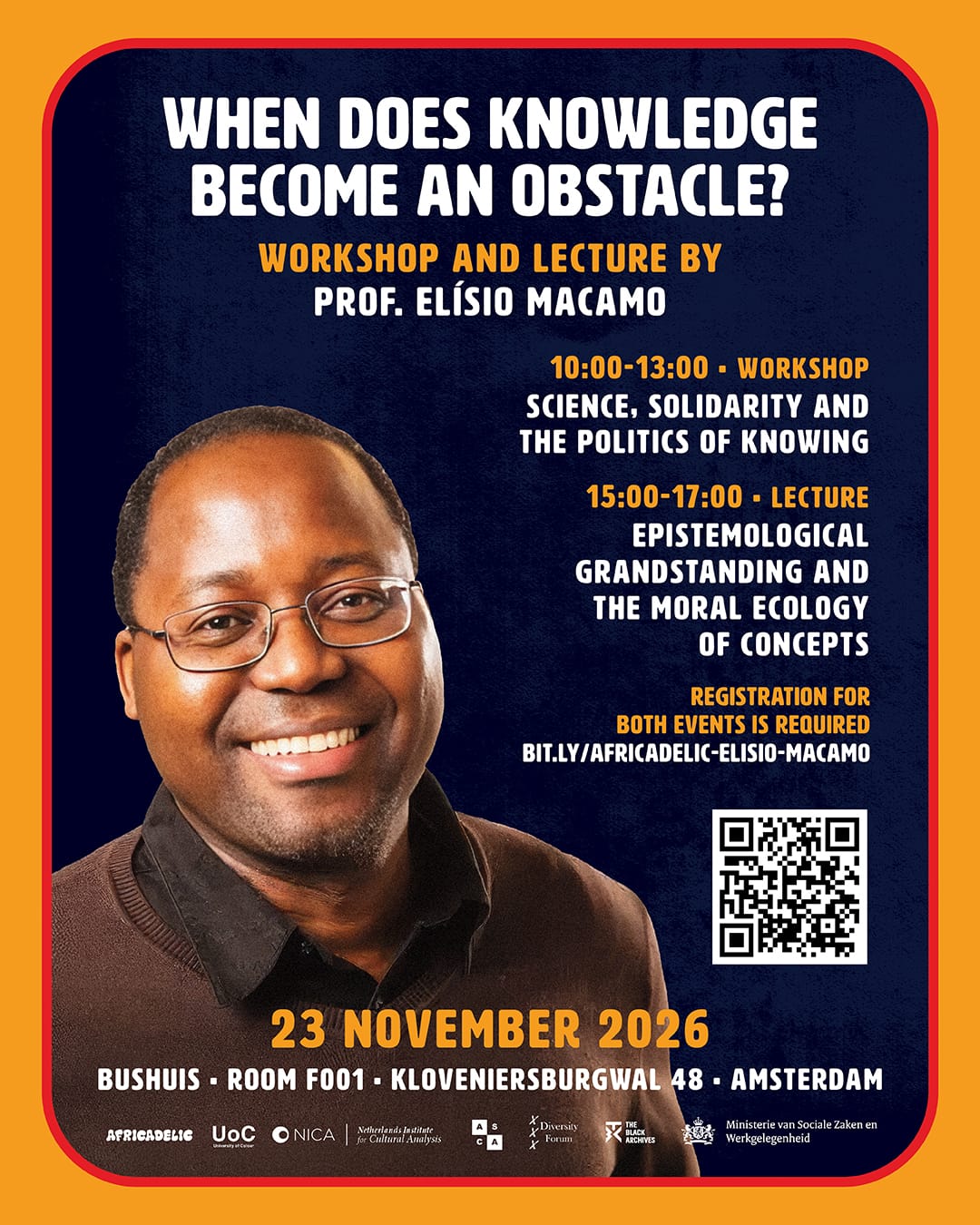
When Does Knowledge Become an Obstacle?
Two events, on Monday 23 November 2026, with Dr. Prof. Elísio Macamo, Professor of Sociology, with a focus on Africa, University of Basel | Organized by: University of Colour, Diversity Forum, ASCA, NICA, Africadelic | Workshop Room, on the ground floor of the Bushuis, room F001, Kloveniersburgwal 48, 1012 CX Amsterdam
Event details from: When Does Knowledge Become an Obstacle?
- Date
- 23 November 2026
- Time
- 10:00 – 17:00
- Room
- Workshop Room, on the ground floor of the Bushuis, room F001, Kloveniersburgwal 48, 1012 CX Amsterdam
Please sign up with this form. Of course you may attend both events. For questions or inquiries, please email: cgdiversity@gmail.com
Event 1: Teach-In/ Workshop
Monday, 23 November 2026, 10-13:00 hours | Workshop Room, on the ground floor of the Bushuis, room F001, Kloveniersburgwal 48, 1012 CX Amsterdam
Event 2: Lecture
Monday, 23 November 2026, 15-17 hours | Same location.
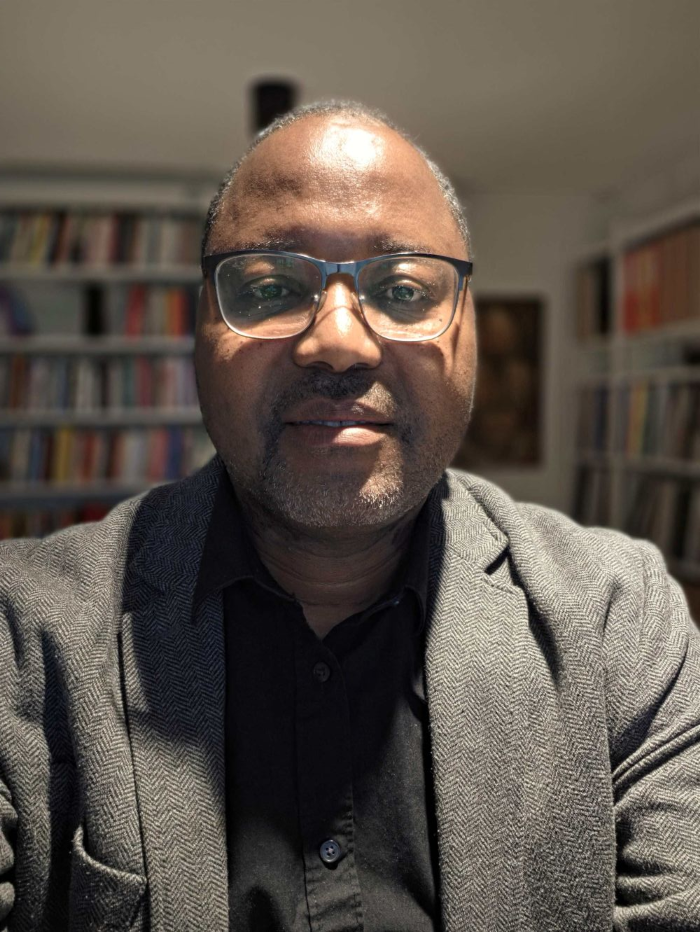
Dr. Prof. Elísio Macamo is Professor of Sociology with a focus on Africa at the University of Basel (since October 2009). He previously taught development sociology at the University of Bayreuth, where he was a founding member of the Bayreuth International Graduate School of African Studies. He was born and grew up in Moçambique. He studied in Maputo (Mozambique), Salford and London (England) and Bayreuth (Germany). He holds a Masters in Translation and Interpreting (Salford), a Masters in Sociology and Social Policy (University of North London) and a PhD and Habilitation in General Sociology (Bayreuth). He was Post-Doctoral Fellow in Bayreuth, Research Fellow at the Center for African Studies in Lisbon (Portugal), AGORA-Fellow at the Wissenschaftskolleg zu Berlin and visiting lecturer at the Eduardo Mondlane University in Moçambique.
Event 1: TEACH-IN/ WORKSHOP
When Does Knowledge Become an Obstacle? Science, Solidarity and the Politics of Knowing
Format: Participatory Workshop, ideally 20–30 participants
The workshop explores the question of when the production of knowledge can become an obstacle to the people, struggles or realities it seeks to understand. Rather than asking participants whether their research is sufficiently “decolonial”, the workshop examines the practical relationships created by knowledge, i.e., who acquires the authority to describe a problem, whose categories become authoritative, what becomes visible through those categories, and what disappears.
The underlying tension is deliberately left unresolved. Science requires enough distance to discover things that social actors themselves may not know, while solidarity requires enough proximity to take seriously what people know about their own circumstances. Distance can become epistemic arrogance, but proximity can also turn research into confirmation. The workshop asks participants to explore this tension rather than choosing one side.
For the NICA 1-credit, by November 21, 2026. please fill out the above Google Form above, and select the option with NICA.
The readings will be sent by email a week before the Teach In/ Workshop:
For the NICA credits:
- you must attend the workshop, and
- also pick from one of the three options:
1. Consider the following readings and formulate one question from these readings. (250-400 words).
2. Alternatively, you may also formulate a question around the workshop description, extrapolating towards how you understand the ‘decolonial’ to function in your deliberations on it. (250-400 words).
3. A final possibility, is to think through the etymologies, connotations and/or intellectual histories of ‘knowledge’ in Dutch, English, or in another language that you speak or are familiar with, and deliberate on for them. (250-400 words).
Event 2: Lecture
When does Knowledge Become an Obstacle?Epistemological Grandstanding and the Moral Ecology of Concepts
Elísio Macamo in conversation with Dr. Choolwe Mphanza Muzyamba, AfuSensi!, moderated by Dr. Michael Thomas.
Decolonial thought has made an indispensable contribution to contemporary scholarship by drawing attention to the relationship between knowledge and power. It has challenged the presumed neutrality of categories, exposed the historical conditions under which disciplines and canons emerged, and insisted that questions about who produces knowledge, from where, and under what conditions cannot be separated from the knowledge produced.
This lecture takes these achievements seriously by asking a deliberately uncomfortable question: Might the intellectual resources developed to criticize domination themselves become obstacles to knowledge?
In this lecture, I introduce the notion of “epistemological grandstanding” to describe situations in which concepts function not primarily as instruments of inquiry but as signals of moral and intellectual positioning. Concepts such as coloniality, decolonisation, resistance, epistemicide, Western knowledge or indigenous knowledge may identify important features of the world. Yet, they also circulate within what I call a “moral ecology of concepts”, i.e. an environment in which some descriptions acquire moral authority, certain questions become easier to ask than others, and the perceived virtue of a position can inadvertently substitute for demonstrating its epistemic validity.