Literature’s Refuge: Rewriting the Mediterranean Borderscape
Lecture and Workshop by Will Stroebel organized by Yiorgos-Evgenios Douliakas & Maria Boletsi | Leiden University. Lipsius 1.48 for the keynote, and Lipsius 1.29 for the workshop, 5 March 2026 | Contact info organizers (for registration for the event): g.e.douliakas@hum.leidenuniv.nl | Registration deadline: 25 February 2026
Event details from: Literature’s Refuge: Rewriting the Mediterranean Borderscape
- Date
- 5 March 2026
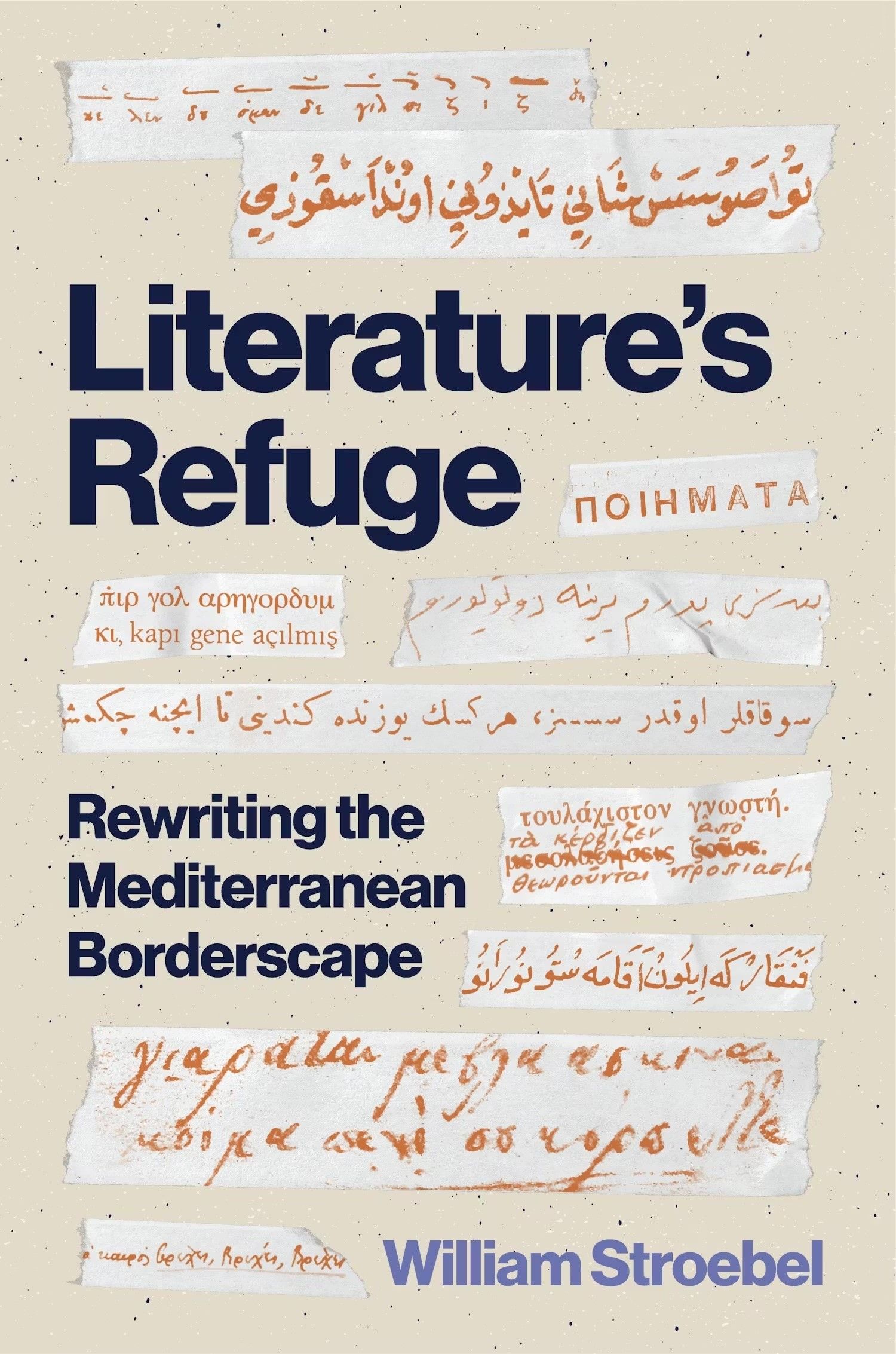
The starting point for the event is Will Stroebel’s recent book, published by Princeton University Press, titled Literature’s Refuge: Rewriting the Mediterranean Borderscape
Literature’s Refuge walks readers through a mostly uncharted geography of refugee and diasporic literatures at the edges of Southeastern Europe and West Asia, pushed off the grid a century ago by the modern border logic that gave birth to the modern Middle East. In 1923, in what amounted to a massive ethnic partition, Greece and Turkey bilaterally agreed to swap their so-called racial minorities: nearly one and a half million Christians of Turkey were uprooted from their homes and dumped into Greece, while almost half a million Muslims from Greece were similarly uprooted and dumped into Turkey. This ethnic cleansing was justified on explicitly humanitarian grounds, for as the High Commissioner for Refugees at the League of Nations declared, “To unmix the populations of the Near East will tend to secure the true pacification of the [region].” Paradoxically, however, the unmixing of the Middle East in fact depended on a massive remixing. Hundreds of thousands of the Christians shunted into Greece spoke not Greek but Turkish, while many of the Muslims deported to Turkey spoke not Turkish but Greek. All of the refugees displayed a startling cultural diversity that found little ground for expression in their new putative homelands. Despite their religious alignment with the national majority, refugees were often ostracized as “foreign spawn” and excluded from public discourse, usually on the grounds of their linguistic and cultural difference.
In other words, the emerging border regime that had displaced these refugees did not end at the border; even in their new settlements, a pervasive borderscape continued to filter refugees through internal systems of differential inclusion, displacing most of them into gray zones of semi-exclusion and silence.
From the status quo of this border regime, Literature's Refuge pries open a place for the displaced: refugee and diasporic literatures whose crossings have been forced underground by cultural institutions on both sides of the partition. Stroebel's book foregrounds the refugee and diasporic literatures that have survived this border regime, ranging from Greek-language Islam (Greek-language literature written in the Arabic alphabet by Greek-speaking Muslims) to Turkish-language Greek-Orthodoxy (Turkish-language literature written in the Greek alphabet by Turkish-speaking Greek Orthodox Christians), with several other case studies in between. Whether treating heretofore unpublished manuscript poetry or well-known figures of world literature, such as C.P. Cavafy, Literature's Refuge provides an unprecedented scope not yet seen in either area studies or the larger disciplinary discussions on world literature. Stroebel's book offers to Comparative Literature a new ground for comparison, neither national nor global but rather the fugitive borderscape between those two scales. This is a book of humble means, using for the most part what we might call the manuscript and ephemeral detritus of national philology, but its goal is lofty: to provide an alternative cartography of the modern borderscape between Europe and the Middle East, which is a small but constitutive mechanism of the larger global border system that regulates our world today. Who belongs where, and who gets to decide?
Workshop description:
Will Stroebel will offer a brief workshop on methodology, focusing on his specialization (book history). The conversation will circle around student interests and how these might be served by book historical methods -- codicology, analytic bibliography, textual criticism, and archival research. Stroebel’s own work has combined book history and border studies to examine how literature, textual cultures, and larger infrastructures of racialized borders intersect and feed one another. Drawing on his own experiences and invoking the experience of other participants, we will discuss practical strategies, how to identify interesting material, and how to incorporate such findings into scholarship in ways that are both plausible and presentable.
Speaker’s bio
Will Stroebel lives and works in Ann Arbor, at the University of Michigan, with a joint appointment in the Modern Greek Program and the Comparative Literature Department. He is a comparatist of Modern Greek and Turkish languages and literatures, driven by an abiding fascination with the diverse faces of Hellenic cultural production in the modern Mediterranean. His book Literature’s Refuge (Princeton UP, 2025) focuses on the first half of the twentieth century, when Greek and Turkish nationalisms were carving up the Aegean into isolated ghettos; working against this national partition, he uncovers ongoing parallels and points of contact between particular Greek- and Turkish-language works of literature, often through the agency of minor and overlooked figures like editors, amanuenses, oral witnesses, and readers-turned-translators or readers-turned-writers. Both his research and teaching are informed by broader interests in Mediterranean Studies, Book History, material networks, and Classical Reception.
More info about his publications is available at: https://sites.lsa.umich.edu/stroebel/
Program/titles:
13:15-13:30 Welcome by organisers
13:30 – 15:00 Workshop with Will Stroebel: “Methodological questions in the intersections of borders, textual cultures, and literature”
15:00 – 16:00 Break
16:00 – 18:00 Book presentation & talk by Will Stroebel: Literature’s Refuge: Rewriting the Mediterranean Borderscape
18:00 – 19:00 Small reception
Credits
NICA/OSL students can obtain 1 to 2 ECs. To obtain 1 EC, they are required to read assigned chapters from the speaker’s book, Literature’s Refuge, and a number of selected texts on methodology, attending both the talk and the masterclass and submitting questions on the assigned material in advance. To obtain 2 ECs, students are required to do all the above, as well as submit a brief reflection piece (ca. 1200 words) after the event.