Spirals and Vortexes: Between the Formal and Geopolitical
2-part series including: A talk with Sophie Mariñez, and respondent Dr. Prof. Michiel Baud on Thursday, November 20, 15-17 hours, REC, room V1.03 and a NICA Seminar with Sophie Mariñez and Joseph Sony Jean on Friday, November 21, 10.00 – 13.00 hours, OMHP kamer C 023. For the NICA Seminar, please write to Alessandra Benedicty-Kokken at a.benedicty@uva.nl. Feel free to attend either or both.
Event details from: Spirals and Vortexes: Between the Formal and Geopolitical
- Start date
- 20 November 2025
- End date
- 21 November 2025
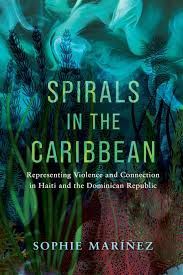
Spirals and Vortexes: Between the Formal and Geopolitical considers what it means to work with a form, present to a given local context, such as the Taíno cave petroglyphs (1200s-1400s) in contemporary Haiti and the Dominican Republic, and work with it as an interlocutor to “problem-space” in our current “conjuncture,” as per David Scott and Stuart Hall. Mariñez will present her book, in conjunction with the following inquiries:
- Work with close reading to generate theory;
- Consider how the local archive might inform concept-work, to articulate concepts grounded in non-mainstream epistemologies, whether indigenous, Africana, Black or related to popular culture. Students are encouraged to think through what it means to generate a conceptual framework that does not correspond to a printed book culture, which might help articulate a current problem-space.
- Consider how the literary, the pictographic (as per Edgar Garcia’s writings), the historical, and also the poetic and/as geopolitical (as per Sophie Mariñez’s writings) might address ‘new forms’ for approaching questions of conflict and genocide, in ways that honor the local contexts (rather than ‘only’ the universals set out by the Universal Declaration of Human Rights (1948)). Much ignored by contemporary media, the current dynamics between the Dominican Republic and Haiti repeat the disavowed violence of a legacy of colonial histories and human rights building.
Sophie Maríñez is an award-winning interdisciplinary comparatist scholar, specializing in French, Francophone, and Caribbean literature, cultural history, and decolonial thought. Her focus includes Afro-diasporic aesthetics, collective memories, and cultural responses to race, ethnicity, gender, and national identity. Her most recent monograph, Spirals in the Caribbean: Representing Violence and Connection in Haiti and the Dominican Republic (Penn Press, 2024), winner of the 2025 Frantz Fanon Award for Outstanding Book in Caribbean Thought, has been hailed in French Studies as: “A masterful and compelling work of scholarship… illuminating the Afro-indigenous struggle for freedom that unites the island’s history.” Drawing on the conceptual and philosophical framework of Spiralisme—a movement initiated by Haitian writers Frankétienne and René Philoctète—Spirals examines the intertwined histories of Haiti and the Dominican Republic from colonization to the present, offering a decolonial perspective on current debates regarding migration, citizenship, and anti-Black racism. Her earlier books include Mademoiselle de Montpensier: Writings, Châteaux, and Female Self-Construction in Early Modern France (Brill, 2017; supported by a National Endowment for the Humanities Stipend) and the co-edited Jacques Viau Renaud: J’essaie de vous parler de ma patrie (Mémoire d’encrier, 2018). Her research has been supported by the ACLS, Mellon Foundation, NEH, and multiple CUNY fellowships and awards. In the fall of 2025, Maríñez is serving as a Visiting Professor at the Sorbonne Nouvelle–Institut des Hautes Études d’Amérique Latine in Paris, teaching courses on Caribbean history, identities, and national narratives. She has also served as Scholar in Residence at the University of Connecticut and has been invited to speak at the University of Amsterdam, University College Dublin, the University of London, the University of Rochester, Tulane University, Barnard College, and the American Council of Learned Societies. She is Series Editor for Brill’s Caribbean Series, where she oversees publication strategy, peer review, and the development of new lines in translation and scholarly editions. At BMCC, she has served as Deputy Chair and Program Advisor for the Modern Languages Department, chaired hiring committees, led curriculum development, coordinated an international study-abroad program, and served as Faculty Leadership Fellow. A recipient of the BMCC Distinguished Teaching Award, she is committed to public scholarship and interdisciplinary dialogue. Her work and commentary have appeared in The Boston Review, the NEH blog, Tupelo Quarterly, the Graduate Center 34&5 podcast (in Spanish), and other international media. She is trilingual in French, Spanish, and English, with additional proficiency in Portuguese. She is recipient of: Frantz Fanon Award for Outstanding Book in Caribbean Thought, Caribbean Philosophical Association (2025); Mellon/ACLS Humanities Research Initiative (2024); National Endowment for the Humanities Summer Stipend (2012, 2021); Mellon/ACLS Community College Faculty Fellowship (2021); BMCC Distinguished Teaching Award (2021); CUNY William P. Kelly Research Fellowship (2020); and, the Carolyn G. Heilbrun Dissertation Prize for “an outstanding feminist dissertation in the humanities” (2010).
Joseph Sony Jean is a Haitian archaeologist. He holds a Ph.D. in archaeology from Leiden University. He was an NWO-Veni fellow and a researcher at the Institute of History, Leiden University, and an affiliated researcher at KITLV (Royal Netherlands Institute of Southeast Asian and Caribbean Studies, Leiden). His archaeological research focuses on the long-term landscape transformation of Haiti. He combines ethnographic, historical, oral history and ethnohistorical sources. He is also interested in critical heritage studies, heritage in times of ''disaster'', particularly the politics of heritage and the relationship between contemporary societies and heritage. He is the co-editor of the book Local Voices, Global Debates: The Uses of Archaeological Heritage in the Caribbean, Brill 2024.
Michiel Baud is former Director of CEDLA (until 2018) and emeritus Professor in Latin American Studies at the University of Amsterdam. He graduated in Contemporary History at the University of Groningen in 1982 and received his Ph.D. cum laude in Social Sciences at Utrecht University in 1991. From 1995 to 2000 he was Professor of Latin American Studies at the University of Leiden. He is still connected to CEDLA, The Centre for Latin American Studies at the UvA.
Michiel Baud carried out his Ph.D research in the Dominican Republic, where he studied the social history of a tobacco producing peasantry in the northern part of the country. In doing so he combined traditional historical documentary research with oral history and anthropological fieldwork techniques. After finishing his Ph. D he did research in southern Ecuador, Argentina and North-Eastern Brazil. His current research interests are indigenista ideologies and their influence on present-day academic interpretations of the Andes.
FOR THE NICA CREDITS
For 1 EC:
- Attend the 4-hour graduate seminar with Sophie Mariñez (3-4 hours).
- Read an excerpt of Mariñez’s book, as well as an excerpt from one of the poems studied in Mariñez’s book.
- Choose one of the assignments below: Select an object that involves the concept or materially present notion of a spiral, from any chosen context. A question for the speaker, around the notion of violence and/or connection.
- Select an object that involves the concept or materially present notion of a spiral, from any chosen context.
- A question for the speaker, around the notion of violence and/or connection.
For 2 ECTS (in addition to the 1 EC criteria):
- Choose one of the below: If an analytic paper, then 500-1000 words; If a plan for an artistic piece, then a description of the piece (500 words), with a visual, sonic, or olifactory to accompany it; If a lesson plan, description of student age group, with a 1 page lesson plan.
- If an analytic paper, then 500-1000 words;
- If a plan for an artistic piece, then a description of the piece (500 words), with a visual, sonic, or olifactory to accompany it;
- If a lesson plan, description of student age group, with a 1 page lesson plan.
A NICA Seminar with Sophie Mariñez and Joseph Sony Jean on Friday, November 21, 10.00 – 13.00 hours, OMHP kamer C 023. For the NICA Seminar, please write to Alessandra Benedicty-Kokken at a.benedicty@uva.nl